Cyrus Kiani
Founder / CEO



📉 Download Decline: A Five-Year Trend
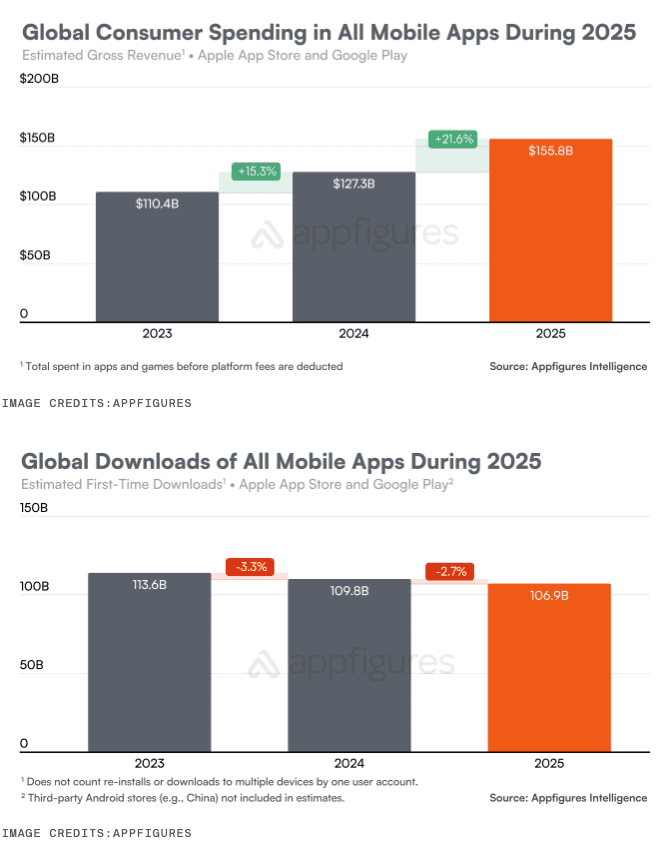
According to the data, global mobile app downloads fell to an estimated 106.9 billion in 2025, representing a 2.7 % year-over-year decline — and marking the fifth consecutive year of declining download volume.
This is notable because download growth has historically been a signal of market expansion. However, this trend has reversed since the pandemic years when installs peaked.
What’s driving the decline?
Market saturation in developed regions
Higher user acquisition costs
More discerning consumer behavior
Increased emphasis on retention over acquisition
For startups, this reinforces a key reality of 2026: growth is no longer about sheer download volume — it’s about quality engagement and retention.
💰 Spending Surge: Monetization Winning Over Volume
Perhaps the most striking takeaway is that consumer spending rose approximately 21.6 % to nearly $156 billion in 2025, despite fewer downloads.
This divergence between downloads and revenue highlights several market shifts:
1. Subscriptions Are Dominating Revenue Models
Subscription services and in-app purchases — especially in non-game apps — have become core revenue drivers. Apps that offer ongoing value through subscriptions or recurring transactions are attracting more spend even without massive install numbers.
2. Non-Game Apps Are Gaining Ground
While mobile games still represent a substantial part of the total spend, non-game apps saw 33.9 % growth in spending, outpacing games in overall spending increases.
This suggests that utility, productivity, lifestyle, and service-based apps are becoming more monetizable — a positive sign for startups outside of gaming.
3. U.S. Market Continues to Spend Big
U.S. consumers contributed significantly to this spending rise, spending roughly $55.5 billion in 2025 — an 18.1 % increase year-over-year — despite a drop in downloads.
For startups targeting the U.S., this underscores the importance of monetization strategy over purely aggressive user acquisition.
📊 What This Means for Startups and App Developers
This shift has several strategic implications:
👉 Monetization First — Not Growth First
With declining downloads but rising revenue, startups should prioritize:
Subscription models
In-app purchases
Premium features
Enhanced user value
This shifts product strategy from acquiring users to monetizing users — creating apps that users are willing to pay for.
👉 Focus on Retention Over Acquisition
Since fewer downloads don’t mean fewer active users, retention metrics are a more reliable success indicator than install counts. Apps with strong onboarding, personalization, and value-driven experiences are more likely to keep users engaged — and spending — over time.
In a maturing app market, retained users are worth more than new installs.
👉 Segment Strategy: Games vs Non-Games
Gaming apps still generate significant revenue, but non-game apps are growing faster in monetization. Startups outside of gaming — such as health and fitness, finance, productivity, or utility apps — should lean into subscription and service-based monetization to capitalize on this trend.
🚀 Strategic Takeaways for 2026 App Builders
If you’re a startup planning to launch or grow a mobile app, here are key lessons from the 2025 market data:
1. Think Long-Term Value
Monetization strategies that emphasize ongoing value (subscriptions, premium content, service upgrades) outperform one-time install revenue.
2. Invest in Retention Tools
Growth isn’t just about installs anymore. Apps that drive daily value — notifications, personalized feeds, adaptive UX — retain more users and capture more spending.
3. Leverage Data to Inform Product Decisions
Analytics should guide product roadmaps rather than install counts alone. By focusing on engagement metrics, startups can design features that users pay for and stick with.
4. Prioritize Monetization Early
Rather than postponing revenue models until after scale, successful startups are building monetization into early versions of their products — aligning growth and revenue right from the start.
📌 Final Thoughts: A New Era for Mobile Apps
The 2025 data — downloads declining while consumer spending rises — underscores a major evolution in the mobile app economy. Success in 2026 is less about chasing installs and more about creating sustainable business models built on retention and monetization.
For startups and developers, this means:
✔ Understanding user behavior deeply
✔ Designing apps that deliver ongoing value
✔ Crafting monetization models that align with user needs
✔ Prioritizing long-term engagement over rapid growth
The future belongs to apps that don’t just attract users — they retain and monetize them.