Cyrus Kiani
Founder / CEO

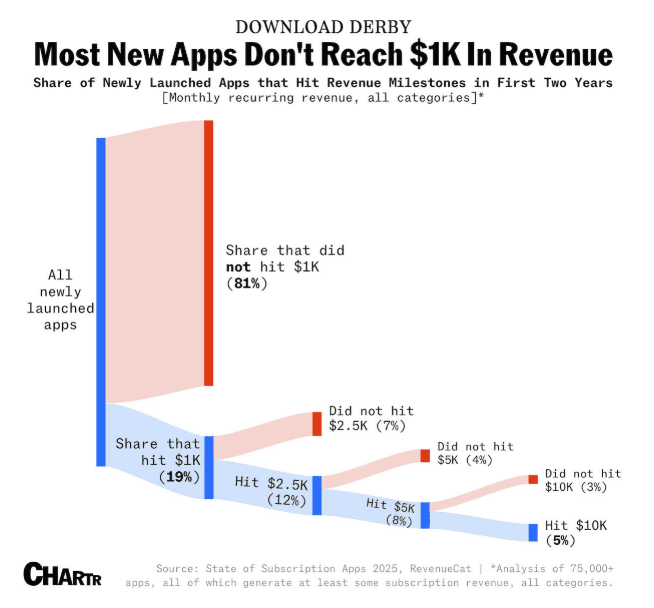
Recent industry data shows that 81% of newly launched apps never reach $1,000 in monthly recurring revenue.
And that was before AI tools dramatically lowered the barrier to building software.
Today, launching an app is faster than ever. AI can generate code, scaffold UI, connect APIs, and even help deploy to app stores. As a result, we’re entering an era where more apps will be launched than ever before.
But here’s the reality:
More apps launching does not mean more apps succeeding.
In fact, the percentage reaching meaningful revenue milestones may shrink.
AI Makes Development Faster — Not Easier
There’s a growing narrative that “building an app is easy now.”
It isn’t.
AI accelerates development, but building a scalable, revenue-generating product is still complex and high-risk. The difficulty has simply shifted.
AI can help you:
Generate boilerplate code
Build MVP interfaces
Connect basic backend services
Speed up prototyping
But AI cannot replace the strategic and architectural decisions that determine whether an app becomes a business.
Why Most Apps Fail (Even With AI)
The apps that struggle aren’t failing because they couldn’t ship.
They fail because they skipped:
1. Market Segmentation
Understanding exactly who the product is for — and who it’s not for — is foundational. AI doesn’t define your niche.
2. Competitive Positioning
In crowded app categories, differentiation is everything. AI tends to reproduce patterns it has seen before, not invent bold positioning.
3. Monetization Strategy
Subscription modeling, pricing psychology, lifetime value optimization, and revenue experiments require strategic thinking and iteration.
4. Retention Architecture
Push notifications, onboarding flows, habit loops, and engagement systems are behavioral design problems — not just engineering tasks.
5. A/B Testing Discipline
Sustainable growth requires experimentation frameworks, data interpretation, and decision-making under uncertainty.
AI Doesn’t Take Design Risks
One of the most overlooked limitations of AI in app development is this:
AI optimizes for patterns. It does not take creative risks.
Breakout apps often win because they:
Break conventional UI patterns
Challenge category norms
Introduce new interaction models
Create emotional differentiation
AI rarely proposes something bold enough to stand out in a saturated market.
That human design intuition — knowing when to push boundaries — is often the difference between a forgettable app and a category leader.
The Technical Limitations of AI-Generated Apps
Beyond strategy and design, there are technical risks.
AI-generated code often:
Lacks long-term architectural cohesion
Introduces hidden technical debt
Misses edge cases and state complexity
Underestimates performance bottlenecks
Implements shallow security practices
Oversimplifies subscription and payment flows
These issues don’t usually surface at launch.
They surface at scale.
And scale is where most apps break.
Launching an App Is a Milestone. Building a Software Business Is Different.
Shipping an app to the App Store is an achievement.
But building a product that consistently generates revenue, scales infrastructure, retains users, and adapts to market feedback is an entirely different challenge.
The difference between a hobby app and a sustainable software business is:
Intentional product strategy
Human-led design decisions
Iterative improvement cycles
Structured experimentation
Long-term technical planning
AI is a force multiplier.
It is not product leadership.
Why Agencies Still Matter in the AI Era
As AI tools improve, the role of experienced product and development teams becomes more important — not less.
Agencies that combine:
Human-centered design
AI-accelerated development
Strategic monetization thinking
Scalable architecture planning
will help founders and businesses avoid becoming part of the 81%.
At TouchZen Media, we leverage AI daily. But we pair it with disciplined engineering, calculated product strategy, and bold design thinking.
Because building software that lasts requires more than speed.
It requires vision.
The Future: More Apps, More Noise, Higher Standards
The market is about to get louder.
More AI-generated apps.
More rapid launches.
More short-lived products.
The companies that win will not be the fastest prompters.
They’ll be the ones who treat software like a long-term asset — built with strategy, resilience, and intentional risk-taking.
If you’re serious about building an app that doesn’t just launch — but scales — the difference won’t be the tools you use.
It will be how you use them.
And who’s guiding the strategy behind them.