Cyrus Kiani
Founder / CEO




Key takeaways
Point | Details |
|---|---|
Full lifecycle coverage | End-to-end development manages every stage from ideation through maintenance, ensuring seamless integration and reducing costly gaps. |
Strategic approach selection | Choosing between PWAs and native apps depends on your budget, timeline, and target audience needs. |
Common pitfalls to avoid | Budget overruns and lack of market validation account for over 70% of startup failures, making careful planning essential. |
Expert partnership value | Working with experienced developers reduces risk and accelerates time to market while maintaining quality standards. |
Ongoing optimization | Post-launch maintenance and user feedback integration are critical for sustained app success and user retention. |
Understanding end-to-end app development
End-to-end app development covers the complete lifecycle of your digital product, from initial concept and market research through design, development, testing, deployment, and ongoing maintenance. This holistic approach ensures every component works together seamlessly, preventing the integration nightmares that derail many startup projects. When you choose end-to-end development, you're committing to a unified strategy where each phase builds logically on the previous one, reducing technical debt and creating a solid foundation for future growth.
Poor integration is the biggest barrierto digital transformation for enterprises, and startups face the same challenge at an even more critical stage. Unlike fragmented approaches where different teams handle separate pieces without coordinating effectively, end-to-end development maintains consistency across your entire technology stack. This unified approach helps you avoid compatibility issues, security vulnerabilities, and performance bottlenecks that emerge when systems don't communicate properly.
The key components of end-to-end development include:
Strategic planning and market validation to ensure you're solving a real problem
User experience design that prioritizes intuitive navigation and engagement
Technical architecture that supports scalability and performance
Development across front end, back end, and API integrations
Comprehensive testing including unit, integration, and user acceptance testing
Deployment strategies that minimize downtime and user disruption
Ongoing maintenance, updates, and feature enhancements based on user feedback
Working with top app developers in the USA gives you access to teams experienced in managing this entire process. They bring proven methodologies, established workflows, and the technical expertise to anticipate problems before they become expensive obstacles. This comprehensive approach differs fundamentally from hiring separate contractors for design, development, and deployment, which often leads to miscommunication and integration challenges that consume your budget and timeline.
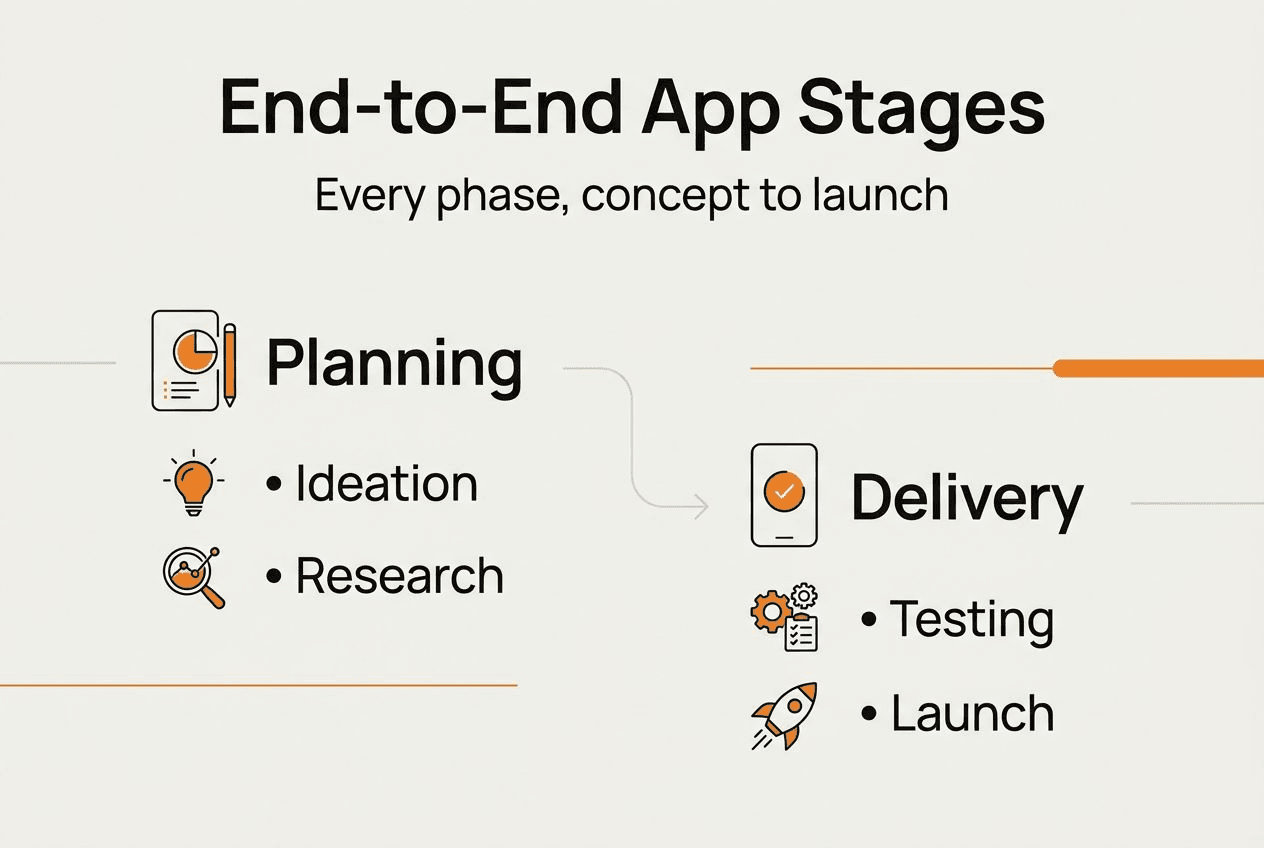
Stages involved in end-to-end app development
The journey from concept to successful app launch follows a structured path with distinct stages, each building on the previous one. Understanding these phases helps you set realistic expectations, allocate resources effectively, and maintain momentum throughout the project. More than 66% of software projects go over budget and 33% run behind schedule due to poor project management, making it essential to grasp what each stage entails.
Here's how the process typically unfolds:
Ideation and discovery where you validate your concept through market research, competitor analysis, and user interviews to ensure genuine demand exists
Strategic planning that defines your minimum viable product (MVP), establishes technical requirements, and creates a realistic timeline and budget
Design phase covering wireframes, prototypes, and final UI/UX that prioritizes user needs and business goals
Development sprint cycles where your team builds features iteratively, allowing for regular testing and adjustments
Quality assurance testing across devices, operating systems, and real-world usage scenarios to identify bugs and performance issues
Deployment to app stores or web hosting platforms with proper monitoring and rollback capabilities
Post-launch optimization including performance monitoring, user feedback collection, and iterative improvements
Agile methodologies work exceptionally well for startups because they allow you to adapt quickly as you learn more about your users and market. Rather than committing to a rigid plan that might not survive first contact with real users, agile development lets you pivot when needed while maintaining forward progress. Top mobile app development companies typically use two-week sprint cycles, giving you regular opportunities to review progress and adjust priorities.
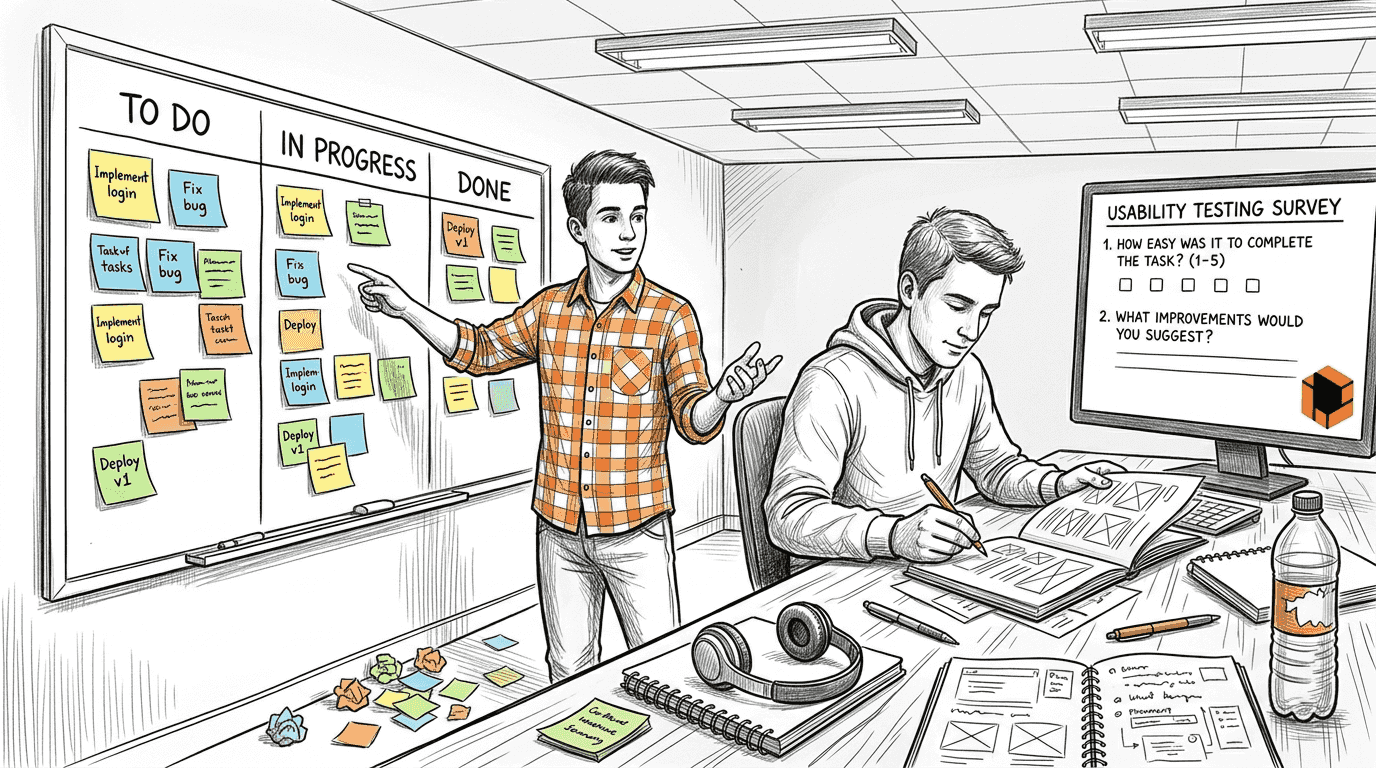
Pro Tip: Involve actual target users in your design phase through usability testing sessions. This early feedback prevents costly revisions later and ensures you're building features people actually want. Even five user interviews can reveal critical insights that save months of development time.
Common pitfalls include scope creep where features keep getting added without adjusting timeline or budget, lack of clear milestones that make it hard to measure progress, and insufficient testing that leads to buggy launches. Following a proven web app design workflow helps you avoid these traps by establishing clear expectations and maintaining disciplined execution throughout the project.
Choosing the right app development approach for your startup
Your choice between Progressive Web Apps (PWAs), native apps, or hybrid solutions significantly impacts your budget, timeline, and user experience. Each approach offers distinct advantages depending on your target audience, feature requirements, and growth plans. Understanding these differences helps you make strategic decisions that align with your business goals rather than following trends that might not fit your situation.
PWAs are ideal for businessestargeting both web and mobile users equally, with instant updates and SEO benefits. They work across all devices through a single codebase, reducing development costs by 40-60% compared to building separate native apps. However, PWAs have limited access to device-specific features like advanced camera controls or background processing, which might restrict certain use cases.
| Factor | Progressive Web Apps | Native Apps | | --- | --- | | Development cost | Lower (single codebase) | Higher (separate iOS/Android) | | Time to market | Faster (2-4 months typical) | Slower (4-8 months typical) | | User experience | Good, improving rapidly | Excellent, full device access | | Update process | Instant, no app store approval | Requires app store review | | Offline functionality | Limited but growing | Full offline capabilities | | Device features | Basic access | Complete hardware integration | | SEO benefits | Strong, fully indexable | None (app store only) | | Discovery | Search engines and direct links | App store search |
When choosing your development approach, consider:
Your target audience's device preferences and technical sophistication
Budget constraints and runway before you need revenue
Feature requirements, especially device-specific functionality
Timeline pressure and competitive landscape
Long-term scalability and maintenance resources
Marketing strategy and user acquisition channels
Pro Tip: Startups should consider starting with a PWA and add native apps later if needed. This lean approach lets you validate market demand and gather user feedback before committing to the higher costs of native development. You can always expand to native apps once you've proven product-market fit and secured funding.
Exploring types of mobile apps startups must know gives you a broader perspective on available options. If you decide native development makes sense for your use case, our native app development guide explains the process in detail. Staying current with mobile app UI trends in 2026 ensures your design choices resonate with modern users who have high expectations for visual polish and interaction patterns.
Common challenges and best practices in end-to-end development
Even with careful planning, startups encounter predictable obstacles during app development. Recognizing these challenges early and implementing proven best practices dramatically improves your chances of success. The statistics are sobering: 38% of startups fail because they run out of cash, and 35% due to a lack of market need. Many of these failures stem from poor execution in the development process.
Common pitfalls that derail startup app projects include:
Budget overruns from unclear requirements or constant feature additions
Poor integration between front end, back end, and third-party services
Insufficient market validation leading to products nobody wants
Inadequate testing resulting in buggy launches that damage reputation
Underestimating ongoing maintenance costs and technical debt
Choosing inexperienced developers who lack startup-specific expertise
Ignoring user feedback and failing to iterate based on real usage data
Two-thirds of surviving startups fail to deliver positive investor returns, often because they built the wrong product or executed poorly on the right idea. The difference between success and failure frequently comes down to how well you manage the development process and respond to market signals.
Best practices that help you navigate these challenges successfully:
Conduct thorough market validation before writing any code, using landing pages, surveys, and customer interviews to confirm demand
Choose experienced developers who understand startup constraints and can work within tight budgets and timelines
Define clear scope with detailed requirements documents and user stories that prevent misunderstandings
Implement agile methodologies with regular sprint reviews to catch problems early
Prioritize ruthlessly, focusing on core features that deliver immediate value rather than nice-to-have additions
Build in analytics from day one to track user behavior and identify improvement opportunities
Plan for ongoing maintenance with 15-20% of initial development budget reserved for the first year
Integrate user feedback loops through in-app surveys, support channels, and usage analytics
Our custom app development guide explores how tailored solutions address your specific business needs rather than forcing you into generic templates. As AI capabilities mature, AI-native mobile app development opens new possibilities for personalization, automation, and intelligent features that differentiate your product. The key is integrating these technologies thoughtfully rather than adding them just because they're trendy.
Successful startups treat development as an ongoing process rather than a one-time project. Your initial launch is just the beginning. Plan for continuous improvement based on user feedback, market changes, and emerging technologies. This mindset helps you stay competitive and responsive as your business grows.
Partner with expert app developers to bring your vision to life
Navigating end-to-end app development requires technical expertise, strategic thinking, and experience managing complex projects under startup constraints. While this guide provides the knowledge you need to understand the process, executing successfully often means partnering with professionals who've built dozens of apps and learned from both successes and failures.
Working with a top app developer in California gives you access to senior developers, designers, and strategists who understand the unique challenges startups face. These teams handle the full lifecycle from initial concept through launch and beyond, letting you focus on business development, fundraising, and customer acquisition while they manage the technical complexities. The right partnership reduces your risk, accelerates time to market, and maximizes ROI by avoiding the costly mistakes that sink many first-time app projects.
Explore top mobile app development companies to find partners with proven track records in your industry. Look for agencies that emphasize collaboration, maintain transparent communication, and involve you in key decisions throughout the process. The best developers act as strategic advisors, not just code factories, helping you make smart choices about features, technology, and go-to-market strategy. Combining strong technical execution with exceptional user experience from top UX designers in the USA creates apps that users love and recommend to others.
Frequently asked questions about end-to-end app development
What does end-to-end app development include?
End-to-end app development covers every stage from initial concept and market validation through design, development, testing, deployment, and ongoing maintenance. This comprehensive approach ensures all components integrate seamlessly and work together reliably, preventing the costly gaps and compatibility issues that emerge when different teams handle separate pieces without coordinating effectively.
How long does this process typically take for startups?
Most startup MVP projects take 3-6 months from kickoff to launch, depending on complexity and feature scope. Simple apps with basic functionality can launch in 8-12 weeks, while more complex platforms with custom integrations and advanced features might require 6-9 months. Working with top app developers in the USA helps you establish realistic timelines based on your specific requirements.
Should startups prioritize PWAs or native apps initially?
Startups with limited budgets should typically start with a PWA to validate market demand quickly and cost-effectively. PWAs cost 40-60% less than native apps and launch faster, letting you test your concept and gather user feedback before committing to more expensive native development. Once you've proven product-market fit and secured funding, you can expand to native apps if your use case requires device-specific features.
What are the key factors influencing project budget in end-to-end development?
Your budget depends primarily on feature complexity, design customization, platform choices, and team experience level. A basic MVP might cost $30,000-$60,000, while more sophisticated apps with custom integrations and advanced functionality typically range from $75,000-$150,000. Ongoing maintenance adds 15-20% of initial development costs annually for updates, bug fixes, and feature enhancements.
How can startups ensure ongoing app success post-launch?
Successful apps require continuous optimization based on user feedback, performance monitoring, and market changes. Implement analytics from day one to track user behavior, run regular surveys to understand pain points, and maintain a roadmap of improvements prioritized by user impact. Reserve budget for ongoing maintenance and feature development, treating your app as a living product that evolves with your business rather than a one-time project.