
Cyrus Kiani
Founder / CEO




Key takeaways
Point | Details |
|---|---|
Hybrid apps use web tech | They combine HTML, CSS, and JavaScript wrapped in native containers for cross-platform deployment. |
Significant cost savings | Development costs drop by up to 40% compared to building separate native apps. |
Performance trade-offs exist | Hybrid apps may lag behind fully native apps in graphics-intensive or complex scenarios. |
Framework choices matter | React Native, Flutter, and Ionic each offer distinct advantages for different startup needs. |
Ideal for MVPs and scaling | Startups validate ideas faster and reach broader audiences with fewer resources. |
What is hybrid app development?
Hybrid app development merges web technologies with native mobile capabilities to create applications that run on multiple platforms from a shared codebase. Unlike native apps built specifically for iOS using Swift or Android using Kotlin, hybrid apps leverage web technologies wrapped in native containers to deliver experiences across devices. This approach differs fundamentally from pure web apps, which run entirely in browsers without device-level access, and from native apps, which require separate codebases for each platform.

The architecture relies on three core components working together. First, developers write the application logic using standard web languages like HTML5, CSS3, and JavaScript. Second, native wrappers package this code into installable applications that app stores recognize. Third, webviews render the interface while plugins bridge the gap to native device features like cameras, GPS, and push notifications.
This structure delivers several immediate benefits for resource-conscious startups:
Write once, deploy everywhere reduces engineering overhead
Faster iteration cycles accelerate time to market
Lower maintenance burden with unified updates
Access to native features through plugin ecosystems
A common misconception treats hybrid apps as glorified mobile websites or diluted native experiences. The reality sits between these extremes. Modern hybrid frameworks produce apps that feel native to users while maintaining the development efficiency of web technologies. They access device hardware, work offline, and appear in app stores just like native applications. The key difference lies in the underlying technology stack, not the user experience quality.
Another myth suggests hybrid apps only suit simple projects. While early hybrid frameworks had limitations, today's tools power complex applications handling real-time data, rich media, and sophisticated interactions. The choice between hybrid and native depends more on specific performance requirements and team expertise than arbitrary complexity thresholds. Understanding these fundamentals helps you evaluate whether cross-platform app development aligns with your startup's goals.
Technologies and frameworks used in hybrid app development
The hybrid app ecosystem centers on several mature frameworks, each bringing distinct philosophies and capabilities. Frameworks like React Native, Flutter, and Ionic dominate hybrid app development in 2026, offering startups proven paths to multi-platform success. Choosing the right framework shapes your development experience, team structure, and long-term maintenance approach.
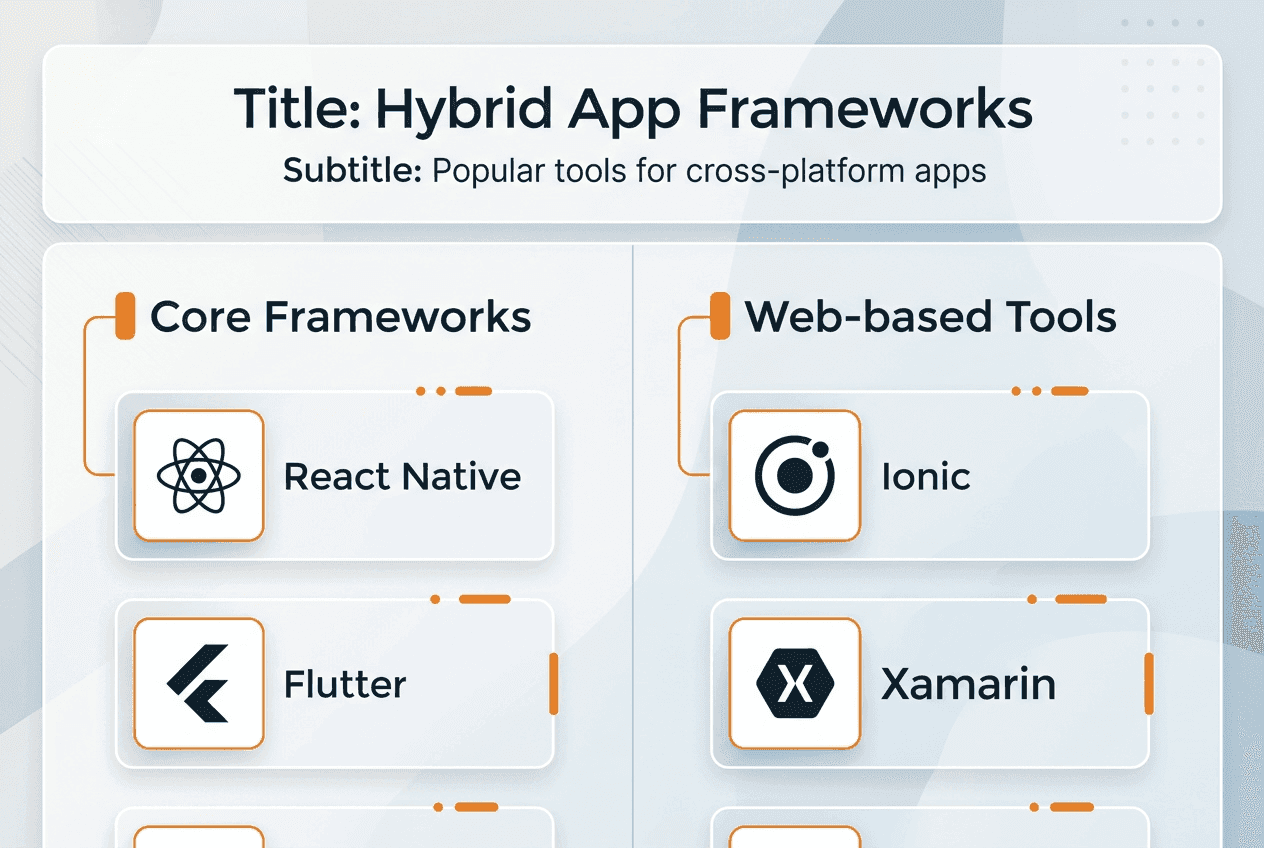
React Native, developed by Meta, uses JavaScript and React to build mobile interfaces that compile to native components. Developers familiar with web development can leverage existing skills while accessing native performance for UI rendering. The framework's massive community produces thousands of third-party libraries, solving common challenges from navigation to state management. Companies like Instagram and Shopify use React Native in production, validating its enterprise readiness.
Flutter takes a different approach, using the Dart programming language and rendering its own UI components rather than wrapping native elements. This architecture delivers consistent visuals across platforms and smooth animations at 60fps. Google's backing ensures regular updates and strong tooling, including hot reload for instant code changes. The framework particularly excels at creating visually rich applications with custom designs that need pixel-perfect consistency.
Ionic builds on web standards, letting developers use HTML, CSS, and JavaScript with frameworks like Angular, React, or Vue. It wraps web apps in native containers using Capacitor or Cordova, providing access to device features through plugins. This approach offers maximum flexibility for teams with strong web development backgrounds. Progressive Web App capabilities mean you can deploy the same codebase as a mobile app or web application.
Xamarin, now part of Microsoft's .NET ecosystem, uses C# to build cross-platform apps with deep integration into Visual Studio. It appeals to enterprises with existing .NET investments and developers comfortable in that ecosystem. While less popular than React Native or Flutter for new startups, it remains relevant in corporate environments.
Pro Tip: Match your framework choice to your team's existing skills and your app's specific requirements. A team fluent in JavaScript might choose React Native, while visual-first projects benefit from Flutter's rendering engine.
Beyond the core framework, plugins and native modules extend functionality when web technologies fall short. Need biometric authentication or AR features? Plugins bridge JavaScript code to platform-specific APIs. This extensibility means hybrid apps rarely hit hard limitations, though implementing custom native features requires platform-specific knowledge. When evaluating frameworks, consider the plugin ecosystem's maturity and whether it covers your planned features. Strong community support around choosing app development frameworks can accelerate development and reduce technical risk.
Advantages and challenges of hybrid app development for startups
Hybrid development reshapes startup economics by changing how you allocate engineering resources. Hybrid apps reduce development costs by up to 40% compared to native apps for startups, a difference that can extend runway or fund additional features. Understanding both benefits and limitations helps you make informed technology decisions.
The advantages stack up quickly for early-stage companies:
Single codebase cuts development time in half versus maintaining iOS and Android separately
Unified updates deploy simultaneously across platforms, reducing coordination overhead
Smaller team requirements mean one set of developers handles both platforms
Faster MVP validation lets you test market fit before heavy native investment
Easier recruitment since JavaScript and web skills are more common than Swift or Kotlin expertise
These benefits compound over time. Every feature you build, every bug you fix, every design change happens once instead of twice. For bootstrapped startups or those racing to market, this efficiency often determines success or failure.
However, hybrid development introduces specific challenges you should anticipate:
Performance gaps appear in graphics-intensive games or apps with complex animations
Native feature access sometimes lags behind platform releases until plugins update
Debugging can be trickier when issues span web code, native wrappers, and device APIs
App size may increase due to framework overhead and bundled web runtime
Platform-specific UI conventions require extra attention to feel truly native
The comparison becomes clearer when examining specific criteria:
Criteria | Hybrid Apps | Native Apps |
|---|---|---|
Development Cost | 40-60% lower | Higher, separate teams needed |
Time to Market | 30-50% faster | Slower, parallel development |
Performance | Good for most use cases | Optimal for all scenarios |
Maintenance | Single codebase updates | Multiple codebases to maintain |
Native Features | Available via plugins | Immediate platform access |
UI Consistency | Requires careful design | Platform conventions built in |
Pro Tip: Startups with limited budgets targeting both iOS and Android users gain the most from hybrid development. If your app relies heavily on device sensors, real-time graphics, or cutting-edge platform features, evaluate whether hybrid frameworks meet your performance requirements before committing.
The notion that hybrid apps look unprofessional or only work for simple projects persists despite evidence to the contrary. Well-designed hybrid apps are indistinguishable from native ones to end users. The quality depends on development skill and attention to platform guidelines, not the underlying technology. Major consumer apps built with hybrid frameworks prove that complexity and polish are achievable. The real question isn't whether hybrid can deliver quality, but whether it aligns with your specific technical requirements and team capabilities. For many startups, especially those prioritizing speed and cost efficiency over absolute performance maximization, hybrid development offers the optimal path to native app development parity at a fraction of the investment.
How startups successfully use hybrid apps: examples and use cases
Real-world startup scenarios demonstrate where hybrid development creates the most value. Many startups have leveraged hybrid apps for MVPs and scaling with fewer resources, validating business models before committing to platform-specific codebases. These patterns reveal strategic opportunities for founders evaluating their development approach.
Consider a health tech startup building a patient engagement platform. They need iOS and Android apps to reach maximum users, but funding limits initial development to six months. Hybrid development lets them launch simultaneously on both platforms, gather user feedback, and iterate quickly. The shared codebase means feature parity across devices, avoiding the fragmentation that frustrates users when iOS gets updates weeks before Android.
E-commerce startups particularly benefit from hybrid's efficiency. A direct-to-consumer brand can build a shopping experience once and deploy it everywhere, from mobile apps to progressive web apps. Product catalogs, checkout flows, and user accounts work identically across touchpoints. When they need to add features like augmented reality try-on, plugins provide native camera access without rebuilding the entire application.
On-demand service platforms represent another sweet spot. A food delivery or ride-sharing startup needs real-time location tracking, push notifications, and payment processing across devices. Hybrid frameworks handle these requirements while letting small teams move fast. As the platform scales, they can selectively optimize performance-critical components with native code while maintaining the hybrid foundation.
Content and media apps showcase hybrid development's flexibility. A news startup can deliver rich multimedia experiences, offline reading, and personalized feeds using web technologies. The same codebase powers their mobile apps and web presence, maximizing content reach. Updates to article templates or recommendation algorithms deploy instantly across all platforms.
Implementing hybrid development successfully follows a clear path:
Define your core features and identify any that might need native performance
Choose a framework matching your team's skills and technical requirements
Build a minimal viable product focusing on user value over technical perfection
Test thoroughly on both iOS and Android to catch platform-specific issues early
Gather user feedback and iterate rapidly, leveraging the shared codebase for speed
Monitor performance metrics and optimize bottlenecks as usage grows
Evaluate whether specific features benefit from native implementation as you scale
This approach balances speed with quality, letting you validate product-market fit before over-investing in technology. The impact on user engagement often surprises founders. When you can iterate weekly instead of monthly, respond to user feedback immediately, and maintain feature parity across platforms, engagement metrics improve. Users appreciate consistent experiences and regular improvements regardless of the underlying technology.
Scaling potential expands significantly with hybrid development. Adding new platforms like tablets or web apps reuses existing code rather than starting from scratch. International expansion happens faster when you update one codebase instead of coordinating across multiple teams. The efficiency gains compound as your user base grows, freeing resources for customer acquisition instead of technical maintenance.
Current design trends further enhance hybrid apps' appeal. Mobile app UI trends 2026 emphasize minimalist interfaces, smooth micro-interactions, and personalized experiences that hybrid frameworks handle beautifully. Modern JavaScript animations rival native performance for most UI transitions. Component libraries provide polished building blocks that accelerate development while maintaining professional aesthetics. The gap between hybrid and native user experiences continues shrinking as frameworks mature and best practices evolve.
Explore expert hybrid app development services
Building a successful hybrid app requires more than choosing the right framework. You need strategic guidance on architecture decisions, user experience design that feels native on each platform, and technical expertise to optimize performance. TouchZen Media specializes in helping startups navigate these challenges, delivering custom hybrid applications that scale with your business.
Our Orange County team brings deep experience across React Native, Flutter, and Ionic, matching technology choices to your specific goals rather than pushing a single solution. We understand startup constraints and priorities, focusing on rapid validation and cost-effective scaling. Whether you're building your first MVP or expanding an existing product to new platforms, our collaborative approach ensures you maintain control while accessing top app developer California expertise. As one of the top mobile app development companies, we combine technical excellence with startup-focused service. Ready to explore how hybrid development can accelerate your mobile strategy? Contact TouchZen Media for a consultation tailored to your unique needs.
Frequently asked questions about hybrid app development
How much does hybrid app development cost compared to native?
Hybrid development typically costs 40-60% less than building separate native apps for iOS and Android. You pay for one development team instead of two, and maintenance costs stay lower over time. Exact savings depend on app complexity and feature requirements.
Can hybrid apps access all device features like cameras and GPS?
Yes, modern hybrid frameworks provide plugins that access virtually all device capabilities including cameras, GPS, biometric sensors, and push notifications. While some cutting-edge features may lag slightly behind native implementation, the gap has narrowed significantly in recent years.
Do hybrid apps perform as well as native apps?
For most use cases including business apps, e-commerce, content platforms, and social applications, hybrid apps deliver performance indistinguishable from native. Graphics-intensive games or apps requiring complex real-time processing may benefit from native development, but typical startup applications perform excellently with hybrid frameworks.
How long does it take to build a hybrid app?
Hybrid apps typically take 30-50% less time to develop than native equivalents. A simple MVP might launch in 8-12 weeks, while more complex applications could take 4-6 months. The single codebase accelerates both initial development and ongoing updates.
Which industries use hybrid apps most successfully?
E-commerce, healthcare, fintech, media, and on-demand services all leverage hybrid apps effectively. Any industry where reaching maximum users across platforms matters more than absolute performance optimization benefits from the hybrid approach. The technology has matured enough to support virtually any business model.