Cyrus Kiani
Founder / CEO



Why Mobile Apps Matter for Startups: Key Benefits in 2026
Startups often view mobile apps as optional extras, something to build after securing funding or reaching profitability. This mindset costs them dearly. Mobile apps create competitive advantages by optimizing investments and unlock customer data that transforms how founders allocate resources. Without an app, you're flying blind, relying on incomplete signals about user behavior while competitors gather precise engagement metrics. The difference between guessing and knowing shapes everything from product development to fundraising success. This article reveals why mobile apps are essential infrastructure for startup growth, backed by research showing how they improve investment efficiency, strengthen market position, and enable the ecosystem advantages that separate winners from failures.
Key Takeaways
Point | Details |
|---|---|
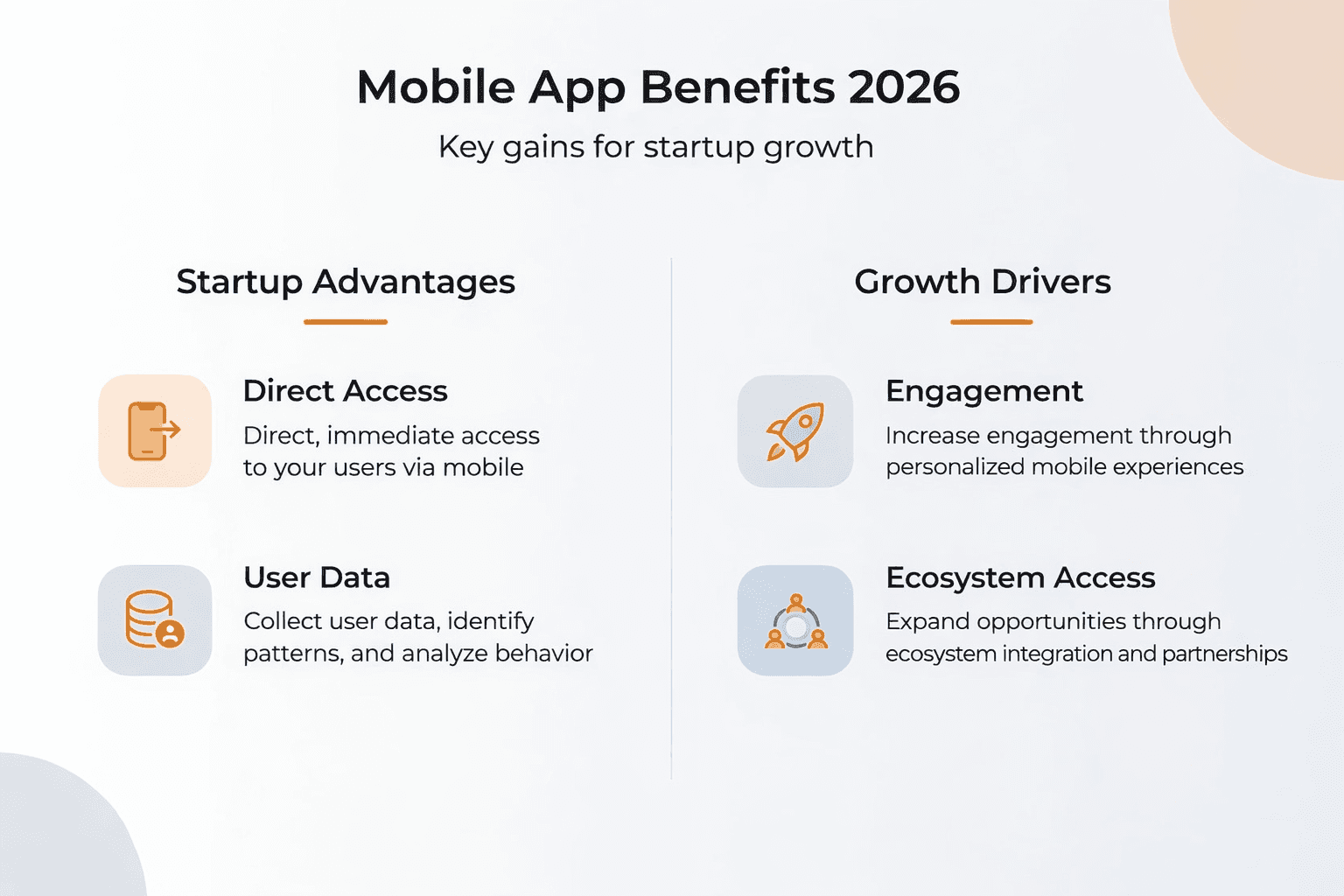
Data driven investments | Apps provide granular behavioral data showing exactly which features drive retention, where users drop off, and what functionality justifies development spend. |
Ecosystem growth advantages | Apps enable participation in digital ecosystems that create network effects and amplify reach without proportional marketing spend. |
Cohort retention tracking | Track cohort retention by acquisition channel within your app to reveal which marketing efforts attract genuinely engaged users and where spending should be optimized. |
Right app approach | Native, hybrid, and cross platform tradeoffs determine time to market, performance, and how easily you can pivot as you learn from users. |
Understanding the competitive advantages mobile apps provide startups
Mobile apps deliver measurable competitive advantages that directly impact your bottom line. Empirical studies confirm mobile apps deliver competitive advantages by reducing over investment through superior customer monitoring. When you rely solely on web analytics or third-party data, you're making funding decisions with incomplete information. Apps provide granular behavioral data showing exactly which features drive retention, where users drop off, and what functionality justifies development spend.

This monitoring capability transforms capital efficiency. Instead of building features based on assumptions or competitor moves, you allocate resources to proven user needs. The data feedback loop shortens dramatically. You test hypotheses in days rather than quarters, adjusting your roadmap based on actual usage patterns instead of survey responses or focus group opinions.
Active user engagement metrics signal product-market fit more reliably than any other indicator. Daily active users, session length, and feature adoption rates tell you whether you've built something people genuinely need. Investors recognize these signals. A startup with strong app engagement metrics commands higher valuations because the data proves market demand exists. You're not selling a vision anymore, you're showing evidence.
Apps also enable participation in digital ecosystems that create network effects. Integration with platform features like push notifications, in-app purchases, and social sharing amplifies your reach without proportional marketing spend. These ecosystem advantages compound over time. Early movers who establish app presence benefit from platform algorithm preferences, featured placements, and the credibility that comes from professional mobile distribution.
Pro Tip: Track cohort retention by acquisition channel within your app. This reveals which marketing efforts attract genuinely engaged users versus those who churn quickly, letting you optimize spend toward high-quality user sources.
The competitive gap widens quickly. Startups without apps struggle to compete on user experience, data quality, and ecosystem participation simultaneously. By the time they recognize the disadvantage, competitors have built insurmountable leads in user base and engagement data. Learn more about mobile app scalability tips to maintain your competitive edge as you grow.
Types of mobile apps startups should consider and how they impact growth
Choosing the right app development approach shapes your startup's trajectory more than most founders realize. Native, hybrid, and cross-platform represent fundamentally different trade-offs between development speed, performance, and maintenance complexity. Your choice determines time to market, user experience quality, and how easily you can pivot as you learn from users.
Native apps built specifically for iOS or Android deliver the best performance and access to platform-specific features. They feel seamless because they use each platform's native UI components and design patterns. Users notice the difference in responsiveness, smooth animations, and integration with device features. The downside hits your budget and timeline. Building separate codebases for iOS and Android roughly doubles development time and maintenance costs. For startups with limited runway, this matters enormously.
Hybrid apps use web technologies wrapped in a native container, letting you deploy one codebase across platforms. Development speed increases significantly, and you maintain a single codebase. However, performance suffers for complex interactions, and achieving truly native look and feel requires extra effort. Hybrid works well for content-focused apps or MVPs where speed to market outweighs performance concerns.
Cross-platform frameworks like React Native or Flutter bridge the gap, offering near-native performance with shared codebases. You write once and deploy everywhere, but with better performance than traditional hybrid approaches. The trade-off involves framework learning curves and occasional platform-specific customization needs. For most startups, cross-platform represents the sweet spot between speed and quality.
Approach | Development Time | Performance | Maintenance | Best For |
|---|---|---|---|---|
Native | Longest | Excellent | Complex | Performance-critical apps, games |
Hybrid | Fastest | Adequate | Simple | MVPs, content apps |
Cross-platform | Moderate | Very Good | Moderate | Most startup use cases |
Your target users and growth stage should drive this decision. Early-stage startups testing product-market fit benefit from hybrid or cross-platform approaches that enable rapid iteration. Once you've validated demand and secured funding, migrating to native makes sense for apps requiring top-tier performance. Companies targeting a single geographic market dominated by one platform might start native from day one.
Pro Tip: Survey your target users about their device preferences before choosing. If 80% use iOS, building native for that platform first lets you focus resources where they matter most.
Explore detailed comparisons in our guide to types of mobile apps to match your startup's specific needs with the optimal development approach.
Design thinking and user engagement strategies that maximize app impact
Design thinking boosts mobile app engagement 40%by centering development around actual user needs rather than assumed requirements. This methodology transforms how startups build apps, replacing feature lists with user journey maps and replacing opinions with tested insights. The engagement gains directly impact your unit economics, customer lifetime value increases when users stick around longer and interact more frequently.
Design thinking starts with empathy research, understanding user motivations, pain points, and contexts before writing a single line of code. You observe how people currently solve the problem your app addresses. These observations reveal opportunities that surveys and interviews miss because users often can't articulate their needs clearly. Watching someone struggle with a workaround shows you exactly where your app can add value.
Iterative testing cycles catch usability issues before they become expensive problems. Prototyping with tools like Figma or Adobe XD lets you test interactions and flows with real users for a fraction of development costs. Each iteration refines the experience based on feedback. By the time you build production code, you've already validated that users understand your interface and can complete core tasks successfully.
User-centered interfaces prioritize clarity over cleverness. Every screen should have one primary action, with visual hierarchy guiding users naturally toward it. Reduce cognitive load by minimizing choices and using familiar patterns. Users shouldn't need instructions to understand your app. If they do, you've failed the design thinking test.
"The best mobile experiences feel invisible. Users accomplish their goals without thinking about the interface, which means designers succeeded in removing friction rather than adding features." – Leading UX researcher
Actionable engagement tactics that startups can implement immediately:
Personalization based on user behavior and preferences increases relevance and session length
Strategic push notifications re-engage dormant users without becoming annoying spam
Simplified onboarding that demonstrates value within 30 seconds reduces abandonment
Progress indicators and achievement systems tap into completion psychology
Social proof elements like user reviews and activity feeds build trust and FOMO
Pro Tip: Conduct usability testing with five users before each major release. Research shows this catches 85% of usability issues at minimal cost, preventing poor reviews and user churn after launch.
Early user testing reduces costly redesigns and increases market fit by validating assumptions before committing resources. A week spent testing prototypes saves months of development on features users don't want or can't figure out how to use. See how mobile app UI trends align with these engagement principles to create experiences users love.
Practical steps for startups to develop effective mobile apps for growth
Building a successful mobile app requires systematic planning that aligns technology decisions with business objectives. Follow these steps to maximize your chances of creating an app that drives measurable growth:
Validate your app idea with target users before development. Create landing pages describing your concept and measure sign-up rates. Conduct problem interviews to confirm the pain point is severe enough that people will change behavior. Validation prevents building something nobody wants.
Choose your development method based on budget, timeline, and performance requirements. Use the comparison framework from earlier sections to match approach with constraints. Factor in post-launch maintenance costs, not just initial development expenses.
Define your MVP scope ruthlessly. List every feature you think you need, then cut it in half. Focus on the single core workflow that delivers value. Everything else waits for version two. Startups die from building too much, not too little.
Build with scalable architecture from day one. Use cloud infrastructure that grows with user base. Implement analytics and monitoring so you know when performance degrades. Design data models that accommodate future features without major refactoring.
Launch to a small user group first. Beta testing with 50-100 engaged users reveals issues that internal testing misses. Gather feedback systematically through in-app surveys and usage analytics. Iterate based on data, not opinions.
Scale gradually while monitoring key metrics. Track daily active users, retention curves, crash rates, and feature adoption. Each metric tells you something different about product health. Set thresholds that trigger investigation when metrics decline.
Maintain continuous improvement cycles. Release updates every 2-4 weeks with bug fixes and incremental enhancements. Regular updates signal active development to users and app store algorithms, improving visibility and trust.
Development Approach | Initial Cost | Time to Launch | Scalability | Flexibility |
|---|---|---|---|---|
Native (iOS + Android) | $80k-150k | 6-9 months | Excellent | Moderate |
Hybrid | $30k-60k | 3-4 months | Good | High |
Cross-platform | $50k-90k | 4-6 months | Very Good | High |
No-code/Low-code | $10k-30k | 1-2 months | Limited | Very High |
Aligning app features with your business model ensures technology supports revenue generation rather than existing as an isolated project. Subscription businesses need seamless payment flows and value delivery that justifies recurring charges. Marketplace apps require trust-building features and transaction infrastructure. Ad-supported apps demand engagement optimization to maximize inventory.
Your growth plans should inform technical architecture decisions. If you're targeting enterprise customers eventually, build with security and compliance requirements in mind from the start. Consumer apps need viral mechanics and social features. Geographic expansion requires localization infrastructure and content management systems.
Learn how to implement these steps effectively through our custom app development guide and discover app scalability tips that prevent technical debt as you grow.
How TouchZen Media can help your startup build impactful mobile apps
You now understand why mobile apps matter and how to approach development strategically. Executing on this knowledge requires expertise that most startups lack in-house. TouchZen Media specializes in iOS and Android app development tailored specifically for startups navigating the challenges you face. We've helped founders transform ideas into scalable products that drive measurable business growth.
Our team combines expert UX design with development approaches that match your stage and constraints. Whether you need a rapid MVP to test market fit or a robust platform ready for scale, we align technology decisions with your business objectives. As an Orange County app development agency recognized among top UX designers USA and top mobile app development companies, we bring proven processes that reduce risk and accelerate time to market. Let's discuss how we can help you build an app that delivers competitive advantages and positions your startup for sustainable growth.
Frequently asked questions
Why do startups need mobile apps?
Mobile apps enable direct customer engagement and data collection that web-only approaches cannot match. They provide the behavioral insights necessary for efficient capital allocation and product decisions. Apps also create competitive advantages through ecosystem participation and superior user experiences that build brand loyalty. Without an app, startups miss critical signals about product-market fit and struggle to compete against better-informed rivals.
What type of mobile app is best for a startup?
The optimal app type depends on your budget, target platform distribution, and performance requirements. Hybrid approaches suit startups prioritizing speed to market and testing hypotheses quickly. Native development delivers the best user experience for performance-critical applications. Cross-platform frameworks balance development speed with quality, making them ideal for most startup scenarios. Evaluate your specific constraints and user expectations using our types of mobile apps guide before deciding.
How can startups ensure their app scales effectively?
Start with cloud-based architecture that grows with your user base without requiring infrastructure overhauls. Prioritize modular feature design so you can add capabilities without refactoring core systems. Plan for user growth by load testing at 10x your current volume. Monitor performance metrics continuously and optimize bottlenecks before they impact user experience. Regular updates based on usage data keep your app aligned with evolving user needs. Implement these mobile app scalability tips to avoid costly rebuilds as you grow.
What role does user engagement play in mobile app success?
Engaged users generate dramatically higher lifetime value through repeat usage, referrals, and willingness to pay for premium features. Engagement metrics signal product-market fit more reliably than vanity metrics like downloads. Design thinking and personalized experiences boost engagement rates significantly, with research showing improvements up to 40%. Focus on removing friction, demonstrating value quickly, and creating habit-forming interactions. Learn how design thinking engagement strategies transform user behavior and drive sustainable growth.