Cyrus Kiani
Founder / CEO




Key Takeaways
Point | Details |
|---|---|
Engagement Impact | User-centric design thinking methods improve app retention rates by up to 40% versus apps developed without structured user feedback loops. |
Cost Efficiency | Iterative prototyping reduces redesign costs by approximately 30% through early problem detection and rapid testing cycles. |
Market Speed | Design thinking improves user satisfaction by 20% and shortens time-to-market by 15% compared to traditional development methods. |
Innovation Driver | Cross-functional collaboration and empathy-driven design lead to scalable product innovation that adapts to changing user needs. |
Common Barrier | Misconceptions about cost and speed prevent many startups from adopting design thinking despite its proven ROI. |
Introduction to Design Thinking in Mobile Apps
Design thinking originated at Stanford's d.school as a human-centered approach to innovation. It prioritizes understanding real user problems before writing a single line of code. For mobile apps, this matters immensely because users make snap judgments within seconds of opening your app.
Your startup faces unique mobile development challenges. Limited screen space demands ruthless prioritization. Users expect instant value or they bounce. Traditional development often misses these nuances, leading to high churn rates and wasted resources.
Design thinking addresses these pain points through five core principles:
Empathy with users drives every design decision
Defining problems clearly before proposing solutions
Ideating multiple approaches rather than settling for the first idea
Prototyping quickly to test assumptions with real users
Testing iteratively to refine features based on feedback
Working with top UX design experts helps startups implement these principles effectively. The methodology shifts focus from what you think users want to what they actually need. This distinction separates successful apps from failed launches.
User churn reduction through design thinking happens because you're solving real problems, not imagined ones. When a fitness app startup discovers users abandon workouts due to confusing navigation, not lack of features, design thinking reveals that insight early. You fix the right problem before investing heavily in the wrong solution.
Why Design Thinking Enhances User Engagement
Empathy-driven design aligns your app with genuine user needs, not assumptions. You conduct interviews, observe behavior, and map user journeys to understand pain points deeply. This foundation ensures every feature serves a purpose users actually care about.
User-centric design thinking methods improve app retention rates by up to 40% versus apps developed without structured user feedback loops. That's not a small advantage. For a startup with 10,000 users, that's 4,000 more people sticking around and potentially converting to paid plans.
Design thinking reduces user drop-off rates by focusing development on user needs and iterative feedback. Here's how to integrate this effectively:
Conduct weekly user interviews during early development phases
Create low-fidelity prototypes and test them with 5 to 8 target users
Analyze behavioral analytics to identify friction points in user flows
Iterate based on qualitative feedback and quantitative data together
Repeat the cycle every sprint to maintain alignment with user needs
A health tracking app discovered through user testing that people wanted quick data entry, not detailed logging. The team pivoted based on this insight, simplifying their interface. Engagement doubled within two months because the app now matched how users actually wanted to track health.

Pro Tip: Don't wait for a perfect prototype. Test rough sketches and wireframes early. Users provide the most valuable feedback when they can still influence core decisions, not after you've committed to an approach.
Partnering with experienced UI/UX design agencies accelerates this feedback integration. They've seen patterns across hundreds of apps and can spot engagement killers you might miss. The investment pays off through higher retention and lower customer acquisition costs.
How Design Thinking Drives Scalable Innovation
Cross-disciplinary teams spark innovation by bringing diverse perspectives to problem solving. When designers, developers, and business strategists collaborate from day one, you avoid siloed thinking. Engineers surface technical constraints early. Designers ensure feasibility doesn't kill creativity. Product managers keep everyone aligned on business goals.
Rapid prototyping cuts redesign costs by roughly 30% because you fail fast and cheap. Building a clickable prototype takes days, not months. Testing it with users reveals flaws before you've invested in full development. You iterate on paper and pixels, not production code.
Iterative testing reduces failure risk substantially. A travel app startup employing design thinking increased user engagement by 60% within three months post-launch by focusing on iterative user feedback. They tested booking flows weekly, refined based on confusion points, and launched with a tested experience.
Key benefits for long-term product adaptability:
User research databases inform future feature decisions
Documented design patterns speed up new feature development
Validated user personas guide marketing and product strategy
Testing infrastructure supports continuous improvement
Pro Tip: Document every user insight in a centralized repository. When planning your roadmap six months later, these insights become gold. You'll spot patterns across multiple feedback cycles that inform strategic pivots.
Implementing cost-reducing agile workflows alongside design thinking maximizes efficiency. Agile provides the development cadence. Design thinking ensures what you build actually matters to users. Together, they create a powerful system for sustainable growth.
A fintech startup used this combination to launch their MVP in four months instead of nine. They prototyped three different onboarding flows, tested each with target users, and implemented only the winner. That focus saved countless development hours on features users would have ignored.
Common Misconceptions About Design Thinking for Apps
Many founders believe design thinking is purely about aesthetics. Wrong. It's empathy-centered problem solving that happens before you choose colors or fonts. Visual design comes later, after you've validated the core user experience through research and testing.
Another myth claims design thinking is too slow and costly for startups racing to market. Actually, it reduces time-to-market by 15 to 25% by catching problems early. Fixing a flawed user flow in prototyping takes hours. Rebuilding it after launch takes weeks and damages your reputation.
Critical failure points to avoid:
Skipping user research and relying on founder assumptions leads to products nobody wants
Omitting rapid prototyping results in expensive development of untested ideas
Ignoring iterative testing means launching with fixable flaws that kill engagement
Treating design thinking as a one-time workshop rather than an ongoing practice
Startups that skip empathy or prototyping face roughly 60% higher failure rates. They build what they think users need, not what users actually struggle with daily. The gap between those two realities sinks products.
Educating your team to use design thinking holistically requires commitment. Everyone from engineers to marketers should understand the methodology. When developers grasp why you're testing before coding, they contribute better solutions. When marketers understand user pain points deeply, they craft messages that resonate.
The biggest misconception? That design thinking replaces other methodologies. It doesn't. It enhances them by ensuring user needs stay central throughout development, regardless of whether you use agile, lean, or another framework.
Comparing Design Thinking with Other Development Methodologies
Design thinking improves user satisfaction by 20% and shortens time-to-market by 15% compared to traditional methods. Understanding these differences helps you choose the right approach for your startup's specific needs.
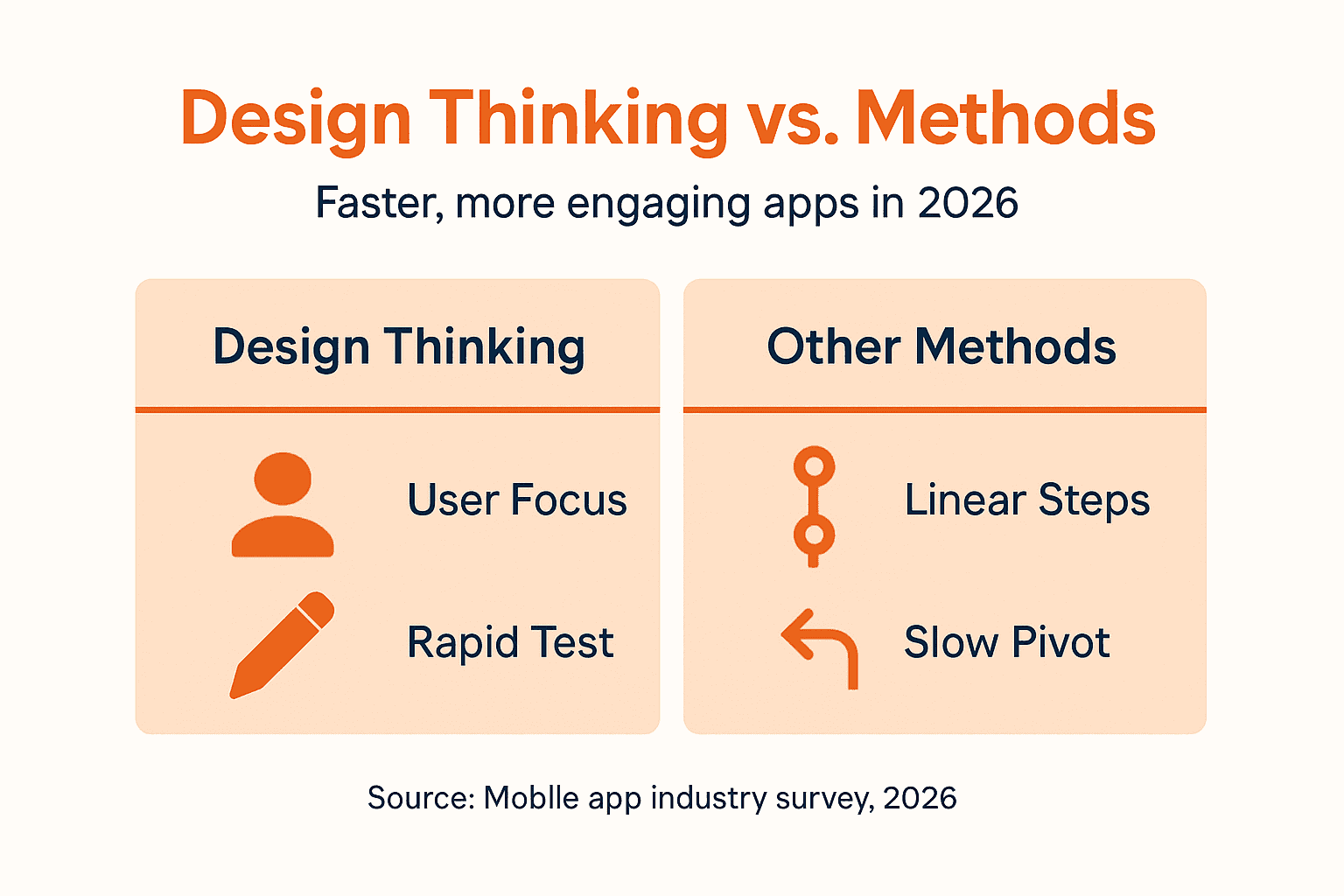
Methodology | User Focus | Flexibility | Time to Market | Best For |
|---|---|---|---|---|
Design Thinking | Deep empathy research and continuous user testing throughout | High adaptability based on user feedback | 15% faster due to early validation | Startups needing product-market fit |
Waterfall | Requirements gathered upfront, limited user input during development | Low flexibility, changes are costly | Slower due to sequential phases | Projects with fixed, known requirements |
Pure Agile | User stories guide development, testing happens in sprints | High flexibility for feature changes | Fast iterations but may lack user research | Teams with clear product vision |
Design Thinking + Agile | Structured user research informs agile sprints continuously | Maximum flexibility with user validation | Fastest validated delivery | Innovative products in uncertain markets |
Design thinking centers on empathy, ideation, and collaboration before development starts. You spend time understanding users deeply, then prototype multiple solutions rapidly. Only after validation do you commit to full development.
Waterfall follows a linear path: requirements, design, development, testing, deployment. Each phase completes before the next begins. User feedback comes late, often after you've invested heavily in the wrong direction.
Pure agile breaks development into short sprints with regular releases. It's iterative and flexible but sometimes lacks structured user research. Teams may iterate quickly on features users don't actually want.
Choose design thinking when you're entering uncertain markets or solving complex user problems. If you're building the tenth iteration of a well-understood product, waterfall might suffice. For most startups, combining design thinking's user research with agile's flexible development creates the best outcomes.
Conceptual Framework and Applying Design Thinking to Apps
The Stanford d.school's five-stage design thinking process provides a structured approach to innovate and iterate app features effectively. Each stage builds on the previous one, creating a systematic path from user problems to tested solutions.
Here's how to apply the framework practically:
Empathize: Conduct contextual interviews with 8 to 12 target users in their natural environment. Observe how they currently solve the problem your app addresses. Document frustrations, workarounds, and unmet needs.
Define: Synthesize research into clear problem statements. Create user personas representing key segments. Map current user journeys to identify critical pain points. Frame problems as opportunities.
Ideate: Generate dozens of potential solutions through brainstorming sessions. Encourage wild ideas initially. Combine concepts. Prioritize based on user impact and technical feasibility.
Prototype: Build low-fidelity versions of top ideas. Paper sketches, clickable wireframes, or interactive mockups work. The goal is testing, not perfection. Spend days, not weeks.
Test: Put prototypes in front of real users. Watch them interact without guidance. Note confusion points. Ask open-ended questions about their experience. Iterate based on findings.
Integrating this within agile design workflows creates a powerful cycle. Run empathy and definition phases before sprint planning. Use insights to inform your backlog. Prototype and test during sprints to validate assumptions continuously.
Common pitfalls destroy the framework's value. Skipping empathy means you're solving imagined problems. Jumping straight to prototyping without defining the real issue wastes effort. Testing with colleagues instead of target users gives false validation.
The benefits for feature-market fit are substantial. You launch knowing users want what you've built because they helped shape it. Scalability improves because your foundation rests on validated user needs, not guesses. As markets evolve, your research practices adapt with them.
Real-World Case Studies of Design Thinking Success
A travel app startup employing design thinking increased user engagement by 60% within three months post-launch by focusing on iterative user feedback. They discovered travelers wanted quick itinerary sharing, not complex trip planning tools. The team pivoted based on this insight, simplifying their core feature set dramatically.
Metric | Before Design Thinking | After Design Thinking | Improvement |
|---|---|---|---|
User Engagement Rate | 22% | 60% | +173% |
Development Cost | $180,000 | $126,000 | 30% reduction |
Time to Market | 9 months | 7 months | 22% faster |
Feature Adoption | 35% | 78% | +123% |
Another startup reduced redesign costs by 30% through rapid prototyping. They tested five different navigation patterns with users before coding. The winning pattern felt intuitive to 85% of testers. The losing patterns would have confused users and required expensive rework post-launch.
Key lessons from successful implementations:
Start user research before writing any code or creating detailed designs
Test with actual target users, not friends or colleagues who don't match your persona
Document insights systematically so the entire team can reference them
Iterate quickly on low-fidelity prototypes before investing in high-fidelity designs
Measure engagement metrics to validate that design changes improve real outcomes
A health app for chronic condition management used design thinking to understand patient daily routines. They discovered users wanted passive tracking, not active logging. The insight led to automated data collection features that tripled daily active usage.
Startups adopting design thinking report 40% higher success rates in achieving product-market fit within the first year. The methodology forces you to validate assumptions early and often. You waste less time building features users ignore and more time refining experiences they love.
For your startup, the practical insight is clear. Invest time understanding users deeply before development. Test cheaply and often. Let real user behavior guide your roadmap, not internal opinions or competitor copying.
Implementing Design Thinking for Startup Apps
Design thinking delivers measurable benefits for startup mobile apps. You've seen how it improves retention by up to 40%, reduces redesign costs by 30%, and accelerates time-to-market by 15 to 25%. These aren't theoretical gains. They're outcomes from startups that prioritized user understanding over assumptions.
Competitive advantages stack quickly:
Higher user retention reduces customer acquisition costs significantly
Faster validated learning helps you pivot before burning resources
Deeper user insights inform marketing messages that resonate
Scalable design systems support growth without constant redesigns
Adopting design thinking starts with small changes. Run user interviews this week. Prototype your next feature before coding it. Test with five target users and iterate based on feedback. These practices compound over time into a user-centered culture.
Collaboration amplifies results. Work with experienced partners who've implemented design thinking across dozens of projects. They'll spot patterns you'd miss and accelerate your learning curve substantially.
Take action now. Your competitors are already using these methods to build better apps faster. Every week you delay is a week of potential insights lost and resources misallocated to unvalidated ideas.
Discover Expert Mobile App Development with Design Thinking
Ready to build a mobile app that users actually engage with? TouchZen Media specializes in user-centered mobile app design that integrates design thinking with agile development. Our top UX design experts have helped California startups improve engagement metrics by an average of 45% through validated design approaches.
We don't just talk about design thinking. We live it. Every project starts with deep user research to understand your target audience's real problems. We prototype rapidly, test continuously, and iterate based on data. Our proven track record shows startups achieving product-market fit faster and scaling more efficiently.
Our agile design workflows combine design thinking's user focus with development efficiency. You get the best of both worlds: apps users love, delivered on time and within budget. Whether you're launching your first MVP or scaling an existing product, we provide the expertise to turn user insights into engaging experiences. Let's discuss how design thinking can transform your mobile app vision into reality.
FAQ
What is design thinking in mobile app development?
Design thinking is a solution-focused, user-centered approach involving empathy, ideation, prototyping, and testing to create effective mobile apps. It prioritizes understanding real user needs through research and incorporates iterative feedback throughout the entire development process, ensuring the final product solves genuine problems.
How does design thinking improve user engagement in apps?
By focusing on real user problems and incorporating continuous feedback, design thinking tailors app experiences to actual user needs rather than assumptions, directly boosting engagement and retention. Iterative prototyping helps teams refine features faster to fit user preferences, eliminating friction points before launch.
Can startups afford the time and cost of design thinking?
Design thinking actually reduces time-to-market by 15 to 25% through early problem detection and lowers redesign costs by approximately 30% via rapid prototyping. It's best viewed as an upfront investment that saves significant time and money over the app's entire lifecycle, making it especially critical for resource-constrained startups.
How is design thinking different from Agile or Waterfall methods?
Unlike Waterfall's rigid linear process or Agile's flexible coding sprints, design thinking centers on empathy and creative problem solving before any development begins. It integrates seamlessly with Agile methodologies but adds critical structured user research and prototyping phases that ensure you're building the right features, not just building features right.
What are the main stages of the design thinking process?
The five stages are Empathize (user research), Define (problem framing), Ideate (solution generation), Prototype (rapid mockups), and Test (user validation). Each stage builds on insights from the previous one, creating a systematic cycle that keeps user needs at the center of every decision throughout development.