Cyrus Kiani
Founder / CEO



What Google AI Overviews Actually Use
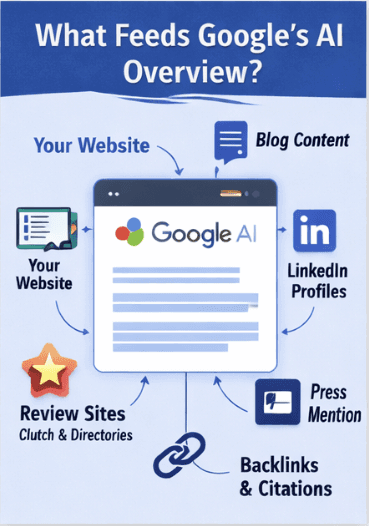
Google AI Overviews generate summaries using information found across the web. This may include:
Your website pages
Your blog content
Public LinkedIn company and founder profiles
Review platforms (Clutch, GoodFirms, directories, etc.)
Press mentions
Industry publications
Backlinks and citations
Structured data and Knowledge Graph sources
It does not rely on just one page — and it does not only read your homepage.
It synthesizes signals.
If your messaging is inconsistent across platforms, AI will reflect that inconsistency.
Why This Matters More Than Ever
If your LinkedIn company description is outdated…
If your blog doesn’t clearly explain your service positioning…
If a third-party directory misclassifies your company…
That’s the information Google may summarize.
And unlike traditional rankings, users may not even scroll past the AI Overview.
Your positioning can be shaped before someone ever visits your site.
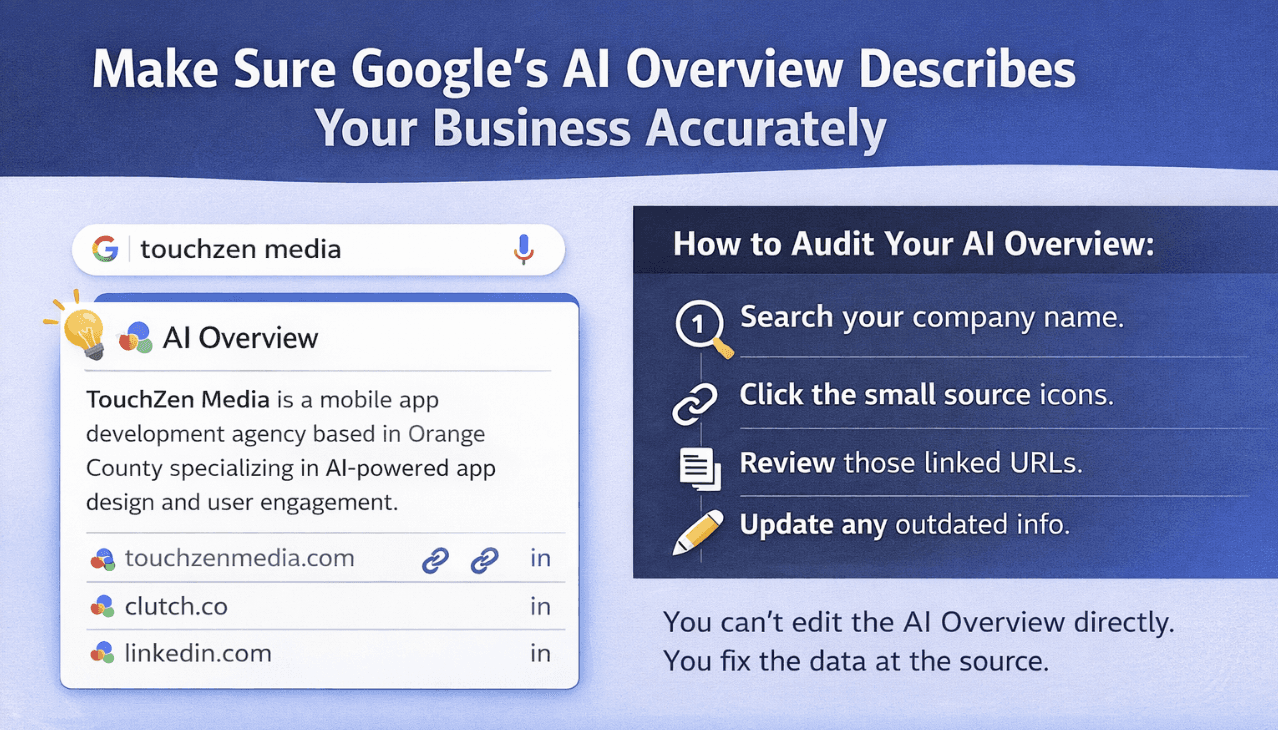
You Can’t Edit the AI Summary Directly
There is no “Edit AI Overview” button.
You don’t control the output.
You control the inputs.
If something is incorrect, vague, or misaligned, the only way to influence the summary is to:
Update your website copy
Refresh your LinkedIn profiles
Correct directory listings
Improve blog clarity
Ensure consistent messaging across platforms
AI Overviews are reflections of your digital footprint.
Step-By-Step: Audit Your Own AI Overview
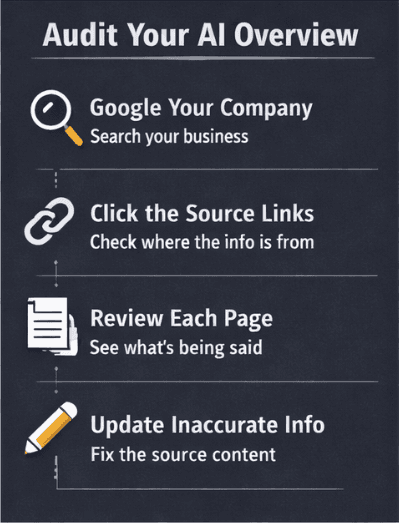
Here’s what every founder or marketing lead should do:
1. Google Your Company Name
Search your business name exactly as users would.
Read the AI Overview carefully.
Does it accurately describe what you do?
2. Search Broader Industry Terms
Try searches like:
“Top [your industry] in [your city]”
“[Your industry] for startups”
“Best [your niche] agencies”
See if your company appears in summaries — and how it’s described.
3. Click the Source Links
Inside the AI Overview, you’ll see small link icons.
Click them.
Open each URL.
Look at exactly what Google is referencing.
You may discover:
An old blog post
A third-party review site
A directory listing you forgot about
A press mention from years ago
This is critical.
Don’t assume the summary is coming from your homepage.
Sometimes it’s pulling from a 2-year-old article that no longer reflects your positioning.
4. Update Information at the Source
If something is inaccurate:
Edit your LinkedIn company description.
Update founder bios.
Refine your service pages.
Add clearer blog content.
Correct directory listings.
You influence AI by improving the content it reads.
The Shift: SEO → Narrative Control
Traditional SEO was about rankings.
AI-driven search is about clarity, authority, and consistency.
The businesses that win in AI Overviews:
Clearly define what they do.
Maintain consistent messaging across platforms.
Publish detailed, helpful blog content.
Earn credible third-party mentions.
Keep profiles and listings up to date.
If your website says one thing, LinkedIn says another, and a directory says something else — AI will blend them together.
Consistency is now a competitive advantage.
What You Should Update Today
As a starting point, review:
Your homepage value proposition
Service pages (are they specific enough?)
LinkedIn company page description
Founder and leadership profiles
Third-party listings (Clutch, GoodFirms, directories)
Blog posts explaining your process and offerings
FAQs that clarify what you actually do
Think of your digital footprint as a data ecosystem.
AI is reading it whether you’re managing it or not.
Final Thought
Google AI Overviews are already summarizing your business.
The only question is:
Are they summarizing the story you want told?
Run the search.
Click the source URLs.
See what it’s reading.
Then optimize the narrative at the source.
Because in the AI era, you don’t just optimize for rankings.
You optimize for interpretation.