
Cyrus Kiani
Founder / CEO



Flutter vs React Native: Expert Advice After 75+ App Builds
Most startups believe React Native automatically delivers faster development, but performance data from 75+ production apps reveals a more complex picture. Choosing between Flutter and React Native isn't about picking the objectively better framework. It's about matching technical capabilities to your specific product goals, team skills, and growth timeline. This analysis draws on empirical benchmarks, developer adoption metrics, and real-world build experience to guide founders and product managers toward evidence-backed framework decisions that align with startup constraints and long-term scalability needs.
Key Takeaways
Point | Details |
|---|---|
Flutter performance edge | Flutter generally outperforms React Native in cold start time, animation FPS, and complex UI rendering, making it advantageous for animation heavy apps. |
Build and size tradeoffs | Flutter builds 15 to 30 percent faster than React Native while producing larger binaries, whereas React Native yields smaller app sizes and slower iteration cycles. |
MVP speed advantages | MVP development is faster with React Native due to JavaScript familiarity and hot reload integration with existing workflows. |
Ecosystem and hiring potential | React Native has a larger ecosystem and hiring advantage, with more job listings and broad npm package support speeding talent acquisition. |
Prototype in real use cases | Prototype in real use cases to confirm that the chosen framework aligns with product goals and team capabilities. |
Flutter and React Native performance comparison
Flutter generally outperforms React Nativein cold start time, animation FPS, and complex UI rendering with metrics like 248ms vs 341ms cold start on Android and 59.7fps vs 56.2fps scrolling. These differences matter most in animation-heavy apps like fitness trackers, gaming interfaces, or real-time data visualizations where frame drops create poor user experiences.

Cold start time directly impacts user retention. When users tap your app icon, Flutter launches 27% faster on Android devices compared to React Native. This advantage compounds in markets with older hardware where every millisecond counts. The performance gap widens further in scenarios requiring simultaneous UI updates, complex transitions, or real-time rendering.
Animation smoothness separates good apps from great ones. Flutter maintains 59.7 frames per second during intensive scrolling operations, while React Native averages 56.2fps. This 6% difference becomes noticeable in gesture-heavy interfaces, parallax effects, or apps featuring custom animations. Users perceive stuttering below 60fps, creating friction that drives abandonment.
App size differences show React Native smaller (10-45MB) than Flutter (15-42MB), while Flutter build times are faster. For startups targeting emerging markets with limited storage or data constraints, React Native's smaller footprint reduces download abandonment. However, Flutter compensates with compilation speeds that accelerate iteration cycles during active development phases.
Build time advantages matter during rapid iteration. Flutter compiles projects 15-30% faster than React Native despite producing larger binaries. Teams shipping daily updates or running extensive A/B tests benefit from shorter feedback loops. The trade-off between deployment size and development velocity depends on whether you prioritize user acquisition in bandwidth-limited markets or team productivity during build phases.
Pro Tip: Evaluate your app's animation requirements early. If your product roadmap includes complex gestures, real-time data visualization, or gaming elements, choosing mobile app frameworks with superior rendering performance prevents costly migrations later.
Developer ecosystem, adoption, and hiring advantages
React Native has 8x more job listings and 58% developer adoption vs Flutter's 9%, benefiting startups needing speed and developer access. This ecosystem size translates directly into hiring timelines, contractor availability, and salary negotiations. Startups competing for technical talent find React Native developers 3-4 weeks faster to source than Flutter specialists.
The npm package ecosystem gives React Native immediate access to 2+ million packages covering authentication, payments, analytics, and specialized business logic. Flutter's pub.dev hosts fewer mature packages, forcing teams to build custom solutions for edge cases. This gap matters when integrating legacy systems, third-party APIs, or industry-specific tools where pre-built connectors save weeks of development.
MVP development speed favors React Native for three key reasons:
JavaScript knowledge transfers directly from web development, reducing onboarding time for full-stack teams
Hot reload and debugging tools integrate seamlessly with existing React workflows
Mature documentation and Stack Overflow coverage solve common problems faster
Startups with existing web products gain additional advantages. Teams already maintaining React codebases reuse components, state management patterns, and business logic across mobile and web platforms. This code sharing reduces the effective cost of mobile development by 30-40% compared to learning entirely new frameworks.
Hiring implications extend beyond initial development. When scaling teams or replacing departing developers, React Native's talent pool depth prevents project delays. Flutter specialists command 10-15% higher salaries in competitive markets, adding recurring cost pressure as teams grow. For bootstrapped startups or seed-stage companies, these hiring economics influence long-term runway calculations.
Pro Tip: Audit your existing team's JavaScript and React expertise before committing to frameworks. Leveraging current skills through our cross-platform app guide approach reduces training costs and accelerates your first release by 4-6 weeks.
Lessons from 75+ app builds: balancing performance and practicality
Experienced developers recommendReact Native for MVPs/startups needing speed and Flutter for performance-critical long-term apps with heavy animations. This guidance emerges from patterns observed across diverse industries, team structures, and product categories. The framework choice creates cascading effects on maintenance costs, feature velocity, and technical debt accumulation.
React Native excels in scenarios prioritizing:
Rapid market validation with minimal upfront investment
Products requiring extensive third-party integrations
Teams with strong JavaScript foundations
Apps where UI complexity remains moderate
Startups optimizing for hiring flexibility
Flutter proves superior for:
Apps demanding consistent 60fps performance
Products with custom UI components and animations
Long-term platforms expecting 3+ year lifecycles
Teams comfortable with Dart or willing to invest in training
Scenarios where build speed impacts daily productivity
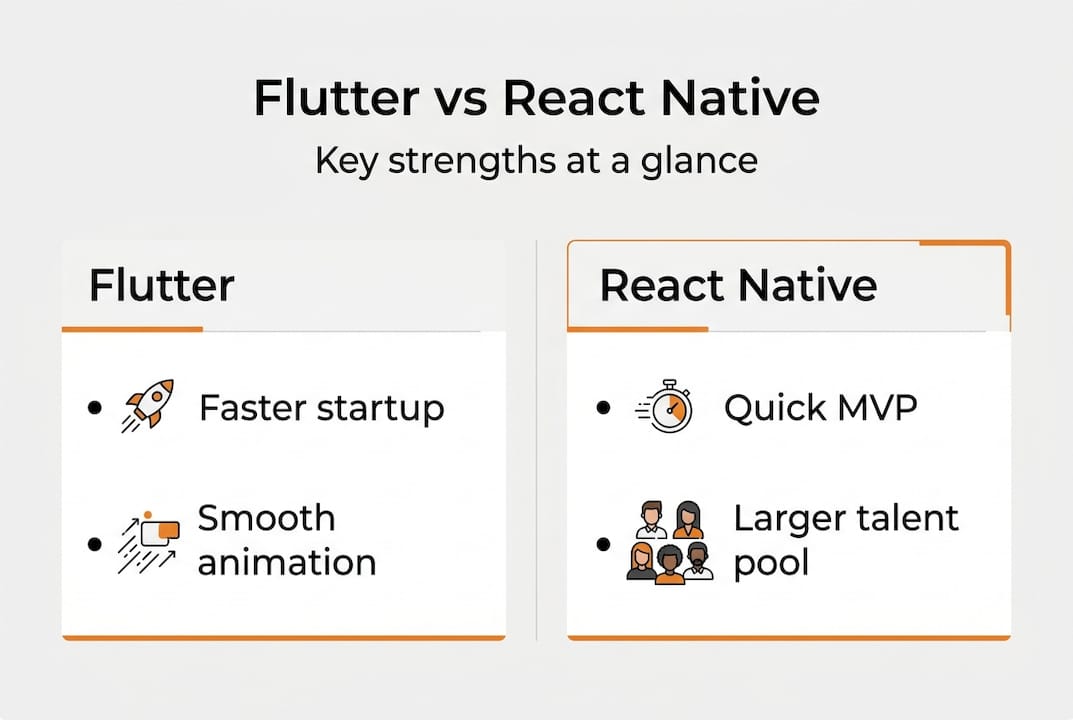
Factor | React Native Advantage | Flutter Advantage |
|---|---|---|
Time to market | Faster MVP with existing JS skills | Faster iteration with superior build times |
Performance | Adequate for 80% of apps | Superior for animation-heavy products |
Talent access | 8x larger hiring pool | Growing but specialized expertise |
Ecosystem maturity | 2M+ npm packages | Smaller but curated package selection |
Long-term maintenance | Community support, mature tooling | Efficient compilation, fewer dependencies |
Expert recommendations suggest hybrid or team-based approaches with prototype testing for critical edge cases like low-end devices. Some successful startups maintain small proofs-of-concept in both frameworks, testing performance on target hardware before full commitment. This validation investment costs 2-3 weeks but prevents expensive pivots six months into development.
Best practices from production experience include:
Benchmark on actual target devices, not emulators or flagship phones
Test framework performance with your specific UI patterns and data volumes
Evaluate package availability for your required integrations before deciding
Consider maintenance burden when your initial developers eventually leave
Document framework-specific patterns to preserve institutional knowledge
Hybrid strategies work when teams possess expertise in both ecosystems. Larger startups sometimes build performance-critical features in Flutter while maintaining standard screens in React Native. This approach requires careful architecture planning and adds integration complexity, but optimizes each framework's strengths. Smaller teams should avoid this complexity until reaching Series A scale.
The app scalability tips we've documented show that framework choice impacts scaling costs differently. React Native's larger talent pool reduces hiring friction during growth phases, while Flutter's performance characteristics prevent costly rewrites when user bases expand beyond initial projections.
Practical recommendations for startups choosing a framework
Both frameworks approach near-native performance for most apps; choice relies heavily on project specifics and team skills. This reality liberates founders from seeking the objectively superior option and refocuses decisions on strategic fit. The framework serving your specific constraints and goals outperforms the theoretically better alternative every time.
Evaluate these criteria systematically:
Performance requirements: Does your core value proposition depend on smooth animations, real-time updates, or complex UI interactions?
Team composition: What's your existing skill distribution across JavaScript, React, Dart, and mobile development?
MVP timeline: How quickly must you validate product-market fit before runway concerns force pivots?
Ecosystem needs: Which third-party services, APIs, and integrations are non-negotiable for your business model?
Hiring roadmap: How many developers will you need in months 6-18, and what's your competitive position for talent?
Prototype testing validates assumptions before major commitments. Build a simplified version of your most complex screen in both frameworks, then benchmark on representative devices. This hands-on comparison reveals performance characteristics, development velocity differences, and team comfort levels that abstract comparisons miss. Allocate 2-3 weeks for this validation phase.
Your framework decision checklist:
Identify your three most performance-sensitive features
Survey existing team skills and learning preferences
Research package availability for required integrations
Calculate hiring timelines and salary expectations in your market
Test prototypes on low-end devices matching your target users
Estimate maintenance burden based on team size projections
Consider long-term product roadmap and potential feature complexity
Pro Tip: Involve both engineering and product leadership in framework selection. Technical performance matters, but business constraints around hiring, timeline, and budget often prove decisive. Align framework choice with your mobile app types 2026 strategy and overall product vision.
Long-term maintenance costs vary by framework. React Native's mature ecosystem means more developers can maintain your codebase, reducing dependency on specific individuals. Flutter's efficient tooling means smaller teams can manage complex apps, but specialized knowledge creates key person risk. Factor these operational considerations into total cost of ownership calculations.
Design system implications matter for product consistency. Flutter's widget approach enforces visual consistency across platforms, while React Native requires more discipline to maintain unified experiences. If your brand identity depends on precise design implementation, Flutter's rendering engine provides tighter control. For products prioritizing platform conventions, React Native's native component approach feels more familiar to users.
The mobile app UI trends we track show increasing emphasis on custom animations and branded experiences. These design directions favor Flutter's rendering capabilities, but React Native continues evolving with improved animation libraries and performance optimizations. Stay current with framework roadmaps when planning multi-year product strategies.
Expert app development services for startups
Navigating framework decisions becomes simpler with experienced guidance. Our team has shipped 75+ production apps across both Flutter and React Native, giving us practical insights into which technical choices serve different startup contexts. We've helped founders avoid costly framework migrations by matching technical capabilities to business requirements from day one.
We specialize in translating product vision into technical architecture that scales. Whether you need rapid MVP development with React Native or performance-optimized Flutter apps, our Orange County app developers bring startup-focused expertise to every engagement. Our approach emphasizes practical trade-offs over theoretical ideals, helping you make evidence-backed decisions aligned with your runway and growth projections.
Our services include:
Framework selection consulting based on your specific product requirements
Full-cycle development from concept to App Store launch
UI/UX design optimized for your chosen framework's strengths
Performance optimization and scalability planning
Team augmentation when you need specialized Flutter or React Native expertise
As recognized top app developers USA, we've guided startups through framework decisions that saved months of development time and prevented expensive technical pivots. Our consulting engagements start with deep dives into your product roadmap, team capabilities, and market constraints before recommending specific technical approaches. This business-first methodology ensures technology serves strategy, not the reverse.
FAQ
Which framework is better for a startup MVP?
React Native generally speeds MVP development due to wider developer availability and 58% adoption rates that reduce hiring timelines by 3-4 weeks. The mature npm ecosystem provides pre-built solutions for common features like authentication, payments, and analytics. However, Flutter is preferred if smooth performance and animations are critical even in MVP stages, particularly for fitness, gaming, or visualization apps where user experience depends on 60fps rendering.
How does team expertise influence Flutter vs React Native choice?
Teams strong in JavaScript or React benefit significantly from React Native since existing skills transfer directly to mobile development, reducing onboarding time from weeks to days. This knowledge reuse accelerates MVP timelines by 30-40% compared to learning new frameworks. Teams familiar with Dart or prioritizing UI richness may lean Flutter, especially when building design-forward products requiring custom animations and precise visual control that Flutter's rendering engine provides.
Do Flutter and React Native perform well on low-end devices?
Flutter leads on animation smoothness with 59.7fps vs 56.2fps during intensive operations, making it better for heavy UI apps targeting budget Android devices common in emerging markets. React Native performs adequately for standard interfaces but may struggle with complex animations on devices with limited RAM or older processors. Prototype testing is strongly recommended to verify performance on targeted low-end devices before committing to either framework, as real-world usage patterns often reveal issues that benchmarks miss.
What are maintenance differences between Flutter and React Native apps?
React Native benefits from a large community with 8x more developers and extensive Stack Overflow coverage that accelerates troubleshooting and reduces dependency on specific team members. The mature npm ecosystem means most maintenance tasks have established solutions and community support. Flutter offers efficient build times that speed up bug fixes and feature updates, but its smaller developer base (9% adoption) may affect maintenance if key developers leave, requiring more specialized hiring to sustain long-term development velocity.