Cyrus Kiani
Founder / CEO




Table of Contents
Key Takeaways
Point | Details |
|---|---|
Industry-specific apps require customization to workflows, compliance, and user needs beyond standard features. | Tailored solutions address regulatory demands and domain-specific integrations that generic apps cannot handle. |
Enhanced engagement and compliance adherence are primary benefits of sector-focused development. | AI personalization and regulatory integration build trust while boosting user retention. |
AI, wearable integration, and secure backends power modern industry-specific applications. | These technologies enable adaptive experiences and meet stringent data protection requirements. |
Compliance adds 20-30% to project costs and extends timelines significantly. | Early planning for regulatory requirements prevents expensive redesigns and delays. |
Startups must prioritize features strategically and partner with experienced developers. | Domain expertise ensures your app addresses real user pain points while meeting industry standards. |
Understanding Industry-Specific App Development
Industry-specific app development means creating software customized to the unique workflows, user expectations, and regulatory requirements of a particular sector. Unlike generic apps that serve broad audiences with standard features, sector-tailored app design addresses the nuanced needs of health providers, fitness trainers, or travel operators. Generic solutions fail in regulated industries because they lack compliance frameworks and domain-specific integrations.
Health and fitness sectors showcase this need dramatically. Over 350,000 health and fitness apps exist globally, each competing to solve specialized problems. These apps must integrate with medical devices, comply with privacy laws, and present complex health data in user-friendly formats. A generic fitness tracker cannot handle HIPAA compliance or sync seamlessly with clinical monitoring equipment.
The core differences between generic and industry-specific apps include:
Compliance layers built into architecture from day one, not retrofitted later
User experience designed for domain experts and end users with specific knowledge levels
Integration capabilities with industry hardware like wearables, sensors, or booking systems
Data structures optimized for sector-specific workflows and reporting requirements
Security protocols aligned with industry regulations and threat models
These distinctions fundamentally change development approach, timeline, and costs. You cannot simply add compliance as a feature. It must shape your entire technical foundation and user journey from the start.
Benefits of Tailoring Apps to Specific Industries
Customized apps deliver measurable advantages that generic solutions cannot match. AI personalization boosts engagement by adapting to individual user behavior patterns and preferences. When your fitness app learns a user's workout preferences and adjusts recommendations accordingly, retention rates climb significantly. This adaptive experience creates stickiness that keeps users returning.
Compliance adherence protects your business while building user trust. Health apps handling patient data must meet HIPAA standards to avoid legal penalties and maintain credibility. Users expect their sensitive information to remain secure, and industry-tailored solutions demonstrate your commitment to protection. Regulatory compliance is not overhead but a competitive advantage in sectors where trust matters.
Integration with industry-specific hardware amplifies functionality dramatically. Fitness apps that sync with wearables provide real-time heart rate monitoring and sleep tracking. Travel apps connecting to booking systems and loyalty programs create seamless experiences users value. These integrations transform your app from a standalone tool into an essential part of the user's ecosystem.
Competitive differentiation emerges when you address sector pain points uniquely:
Health apps offering telemedicine integration solve access barriers for rural patients
Fitness platforms with nutrition tracking and workout plans provide holistic wellness management
Travel apps combining itinerary management with real-time updates reduce trip planning stress
Pro tip: Continuously collect user behavior data to refine personalization algorithms. The more your app learns about individual preferences, the more indispensable it becomes to daily routines.
These benefits translate directly to higher user lifetime value and stronger market positioning. Understanding mobile app market trends helps you capitalize on sector-specific opportunities before competitors do.
Technologies Powering Industry-Specific Apps
AI and machine learning form the backbone of modern industry-specific applications. These technologies enable adaptive user experiences that evolve based on behavior patterns. AI drives personalization in health apps by analyzing symptom patterns and suggesting relevant interventions. Fitness apps use machine learning to optimize workout recommendations based on progress tracking and recovery needs.

Secure backend integrations ensure data protection while enabling necessary functionality. Health apps require encrypted communication with electronic health record systems. Travel apps need secure payment processing and identity verification. These integrations must meet industry security standards while maintaining performance and user experience quality.
Wearable and sensor integration defines next-generation health and fitness applications. Continuous glucose monitors, heart rate sensors, and sleep trackers generate streams of physiological data. Your app must process this information in real time, identify meaningful patterns, and present insights users can act on. The technical complexity of managing multiple data streams while maintaining battery efficiency requires specialized expertise.
Key technology considerations include:
Cloud infrastructure choices that support scalability and meet data residency requirements
API design allowing seamless third-party integrations without compromising security
Real-time data processing capabilities for time-sensitive health or travel alerts
Cross-platform compatibility ensuring consistent experiences on iOS, Android, and web
Pro tip: Select your technology stack early based on industry-specific requirements. Switching technologies mid-project to accommodate compliance needs costs time and money you cannot afford to waste.
The right technology choices position your app for growth while ensuring regulatory compliance. Understanding AI and machine learning applications helps you identify which capabilities deliver the most value for your sector and user base.
Key Compliance and Security Considerations by Industry
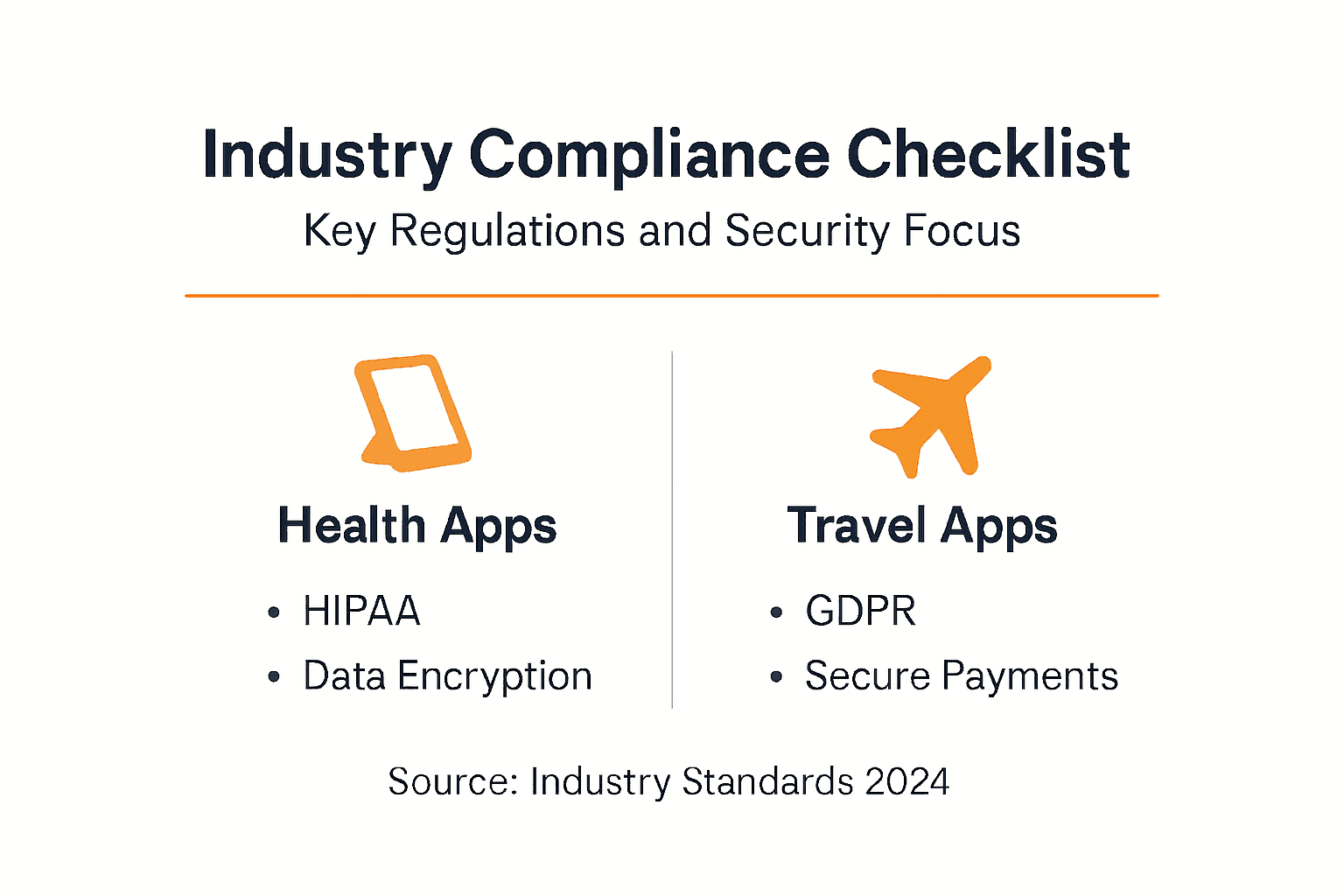
Regulatory requirements vary dramatically across health, travel, and fitness sectors. Health apps handling protected health information must comply with HIPAA, requiring encryption, access controls, and audit logging. Violations carry penalties up to $50,000 per incident, making compliance non-negotiable. Travel apps processing payment data need PCI DSS certification, while fitness apps collecting biometric data face varying state privacy laws.
Compliance complexity impacts development costs and timelines significantly. Adding proper security controls and documentation typically increases project budgets by 20 to 30 percent. Your development schedule must account for security audits, penetration testing, and certification processes. Rushing compliance leads to gaps that expose users and create legal liability.
Industry | Primary Regulations | Complexity Level | Impact on Timeline |
|---|---|---|---|
Health | HIPAA, FDA | Very High | 25-35% increase |
Travel | PCI DSS, GDPR | Moderate | 15-25% increase |
Fitness | State Privacy Laws | Low to Moderate | 10-20% increase |
Security best practices extend beyond minimum regulatory requirements. Implement multi-factor authentication for sensitive accounts. Use tokenization for payment data to minimize breach impact. Conduct regular security audits to identify vulnerabilities before attackers do. These proactive measures protect users and demonstrate your commitment to data protection.
Critical compliance actions include:
Conducting privacy impact assessments before collecting new data types
Implementing data retention policies that automatically delete outdated information
Providing transparent privacy policies written in plain language users understand
Establishing incident response plans for potential data breaches
Training development teams on secure coding practices specific to your industry
Early involvement of compliance experts prevents costly redesigns. Designing for accessibility and compliance from the start ensures your app meets standards without sacrificing user experience or development velocity.
Common Misconceptions about Industry-Specific App Development
Many founders believe industry-specific development simply means adding unique features to a standard app template. This misunderstanding underestimates the architectural changes required. Compliance shapes data models, API design, and infrastructure choices from the foundation. User experience must reflect domain expertise and workflow patterns unique to your sector. Security protocols differ fundamentally between industries based on threat models and regulatory requirements.
Another prevalent misconception treats AI as optional enhancement rather than essential capability. In today's competitive landscape, AI personalization drives engagement that determines whether users stick with your app or abandon it. Health apps without intelligent symptom analysis cannot compete with those offering personalized insights. Fitness platforms lacking adaptive workout recommendations feel generic and quickly lose user interest.
"Over 350,000 health and fitness apps compete globally, making AI-driven personalization essential for standing out in crowded markets."
The third major misconception minimizes compliance impact on budgets and schedules. Founders often allocate 5 to 10 percent for regulatory requirements when the realistic range is 20 to 30 percent. This planning gap creates project overruns and rushed implementations that compromise quality. Compliance is not a checkbox but an ongoing commitment requiring dedicated resources.
Correcting these misconceptions:
Industry-specific development requires holistic architectural thinking, not feature additions to generic templates.
AI capabilities are competitive necessities in health, fitness, and travel apps, not optional enhancements.
Compliance demands significant budget and timeline allocation to implement properly without shortcuts.
User experience design must deeply understand domain workflows and user expertise levels.
Security protocols must align with industry-specific threat models and regulatory frameworks from day one.
Understanding these realities helps you plan accurately and set appropriate expectations. Recognizing what industry-specific development truly entails positions your project for success rather than disappointing compromises.
Real-World Cases of Industry-Specific Apps
Peloton revolutionized home fitness through AI-driven personalized workout experiences. Their app analyzes performance metrics to adjust difficulty levels and recommend classes matching user preferences. Real-time leaderboards and social features create engagement that keeps subscribers active. The integration with proprietary hardware creates a seamless ecosystem users value enough to maintain monthly subscriptions.
MyFitnessPal demonstrates comprehensive nutrition and exercise tracking integration. The app's massive food database combined with barcode scanning simplifies calorie logging. Wearable integration automatically syncs workout data, providing complete health pictures. This holistic approach addresses multiple user needs within one platform, reducing friction and increasing daily usage.
Health monitoring apps showcase compliance integration done right. Apps like Livongo for diabetes management combine continuous glucose monitoring with personalized coaching. HIPAA compliance ensures patient data remains protected while enabling necessary sharing with healthcare providers. These apps prove that regulatory requirements and excellent user experience can coexist when planned properly.
Key success factors from these cases:
Seamless hardware integration that feels natural rather than forced or clunky
AI personalization that delivers genuinely useful recommendations users act on
Social features creating community and accountability that drive continued engagement
Compliance frameworks enabling trust and necessary data sharing without friction
Startups can apply these lessons by focusing on one core problem and solving it exceptionally well. Build integration capabilities early rather than treating them as future additions. Invest in AI that provides real value instead of implementing it as a buzzword feature. Study fitness app case studies and understand why integrated digital strategies outperform fragmented approaches that treat components as separate rather than unified.
Practical Guidance for Startups and Product Managers
Building effective industry-specific apps requires systematic planning and execution. Follow this sequence:
Define your core user problem with precision, focusing on one critical pain point rather than multiple mediocre solutions.
Research regulatory requirements thoroughly before architectural decisions, involving compliance experts from the start.
Choose technology partners with proven domain experience in your industry rather than generalist developers.
Prioritize features based on user impact and compliance necessity, deferring nice-to-have capabilities until core functionality proves solid.
Plan iterative releases that gather user feedback early, allowing course corrections before investing heavily in wrong directions.
Budgeting realistically prevents project failures and compromised quality. Expect development costs 20 to 40 percent higher for industry-specific apps compared to generic solutions. Timeline estimates should include compliance audits, security testing, and certification processes. Allocate contingency budgets for unexpected regulatory requirements or integration challenges that emerge during development.
Feature prioritization balances user needs with technical feasibility and compliance requirements. Use a scoring matrix evaluating each feature on user impact, development complexity, and regulatory necessity. Focus your initial release on features scoring high on impact and necessity while managing complexity. Defer advanced capabilities until you validate core assumptions with real users.
Pro tip: Implement analytics from day one to track feature usage and user behavior patterns. Data-driven iteration dramatically improves your odds of building something users genuinely want rather than what you assume they need.
Choosing the right development partnersdetermines your project's success or failure. Look for agencies with relevant case studies in your industry. Ask detailed questions about their compliance experience and security practices. Verify they understand the regulatory landscape and can guide you through certification processes. Domain expertise saves you from expensive mistakes and accelerates time to market.
Leverage Expert Industry-Specific App Development Solutions
Building a successful industry-specific app requires specialized expertise in compliance, AI integration, and user-centric design. TouchZen Media helps health, travel, and fitness startups transform ideas into market-ready applications that meet regulatory standards while delivering exceptional user experiences. Our team brings proven domain knowledge across sectors, ensuring your app addresses real user needs without compliance shortcuts.
Navigating technology choices becomes simpler when you understand how to choose the right mobile app development framework for your specific requirements. Accessibility should never be an afterthought, and our guide on designing accessible mobile applications ensures your app serves all users effectively. When selecting partners, review our strategic breakdown of top app development agencies) to make informed decisions that align with your goals and budget.
Frequently Asked Questions
What is industry-specific app development?
Industry-specific app development creates software tailored to unique operational, regulatory, and user needs of particular sectors like health, travel, or fitness. These apps differ from generic solutions by incorporating compliance frameworks, domain-specific integrations, and specialized user experiences that address sector workflows and regulations from the foundation rather than as afterthoughts.
How does compliance affect app development costs and timelines?
Compliance typically adds 20 to 30 percent to development costs and extends timelines by similar proportions. Proper implementation requires security audits, encryption protocols, access controls, and documentation that generic apps skip. Involving compliance experts early in architectural planning helps avoid expensive redesigns and delays later in the project.
Why is AI important in health and fitness apps?
AI personalizes user experiences by adapting to individual behavior patterns, preferences, and progress metrics. This personalization drives engagement and retention that determines competitive success in crowded markets. Health apps use AI for symptom analysis and intervention suggestions, while fitness platforms leverage it for adaptive workout recommendations that evolve with user capabilities.
What should startups prioritize when building industry-specific apps?
Focus on core features addressing critical user needs and compliance requirements before expanding functionality. Budget realistically for complexity, allocating 20 to 30 percent more than generic app estimates. Choose development partners) with proven domain experience in your industry who understand regulatory landscapes and can guide you through certification processes without shortcuts that create liability.