
Cyrus Kiani
Founder / CEO




Key takeaways
Point | Details |
|---|---|
Single codebase advantage | Cross-platform development lets you write code once and deploy to iOS and Android, reducing initial development time. |
Framework differences matter | React Native, Flutter, and Xamarin each offer distinct performance, language, and ecosystem tradeoffs that impact your project. |
Cost and UX tradeoffs exist | Lower upfront costs can lead to higher maintenance expenses and UX compromises if not managed carefully. |
Selection depends on goals | Choose frameworks based on your startup’s priorities like speed to market, budget constraints, and long-term scalability. |
Expert guidance accelerates success | Partnering with experienced developers helps navigate framework selection and avoid common pitfalls. |
Introduction to cross-platform app development
Cross-platform app development means building applications that run on multiple operating systems using a single shared codebase. Instead of writing separate code for iOS and Android, you write once and deploy everywhere. For startups, this approach promises faster market entry and lower initial development costs, which matter when you're racing to validate product-market fit.
Three main technology approaches power cross-platform apps. Code sharing frameworks like React Native or Flutter let you write most logic once while rendering native UI components or custom widgets. Hybrid apps wrap web technologies in a native container, using HTML, CSS, and JavaScript. Native wrapper frameworks compile code to platform-specific binaries while keeping a unified development experience.
California's competitive startup market demands presence on both iOS and Android. Users expect polished apps regardless of their device preference. Cross-platform development addresses this need without doubling your engineering team or timeline. Common frameworks include:
React Native for JavaScript developers seeking extensive libraries and community support
Flutter for teams prioritizing high-performance UI and fast rendering
Xamarin for startups already invested in Microsoft's C# ecosystem
Each framework balances development speed, cost efficiency, and user experience differently. Your choice depends on technical skills available, project complexity, and long-term maintenance plans. Understanding these tradeoffs upfront prevents costly pivots later when scaling becomes critical.
Key cross-platform frameworks and technologies
React Native uses JavaScript and a bridge architecture to communicate with native modules. This design lets you tap into a massive ecosystem of libraries and tools built by a global developer community. 72% of startups prefer React Native due to its large developer community and mature ecosystem. The framework supports hot reloading for instant code updates during development, speeding iteration cycles significantly.
Flutter takes a different approach by compiling Dart code directly to native ARM binaries. It uses its own rendering engine called Skia, bypassing platform UI components entirely. This gives Flutter apps consistent appearance across devices and exceptional animation performance. You get pixel-perfect control over every visual element, which matters for brands requiring precise design implementation.
Xamarin leverages C# and .NET to share business logic while still using native UI elements for each platform. Xamarin enables up to 90% code sharing but requires native UI elements, increasing UI development complexity. This framework fits startups with existing Microsoft technology investments or enterprise integration needs.
Here's how these frameworks compare across critical dimensions:
Framework | Language | Performance | Community Size | UI Approach | Best For |
|---|---|---|---|---|---|
React Native | JavaScript | Good | Very Large | Native components | Web developers, rapid prototyping |
Flutter | Dart | Excellent | Growing | Custom rendering | Complex UI, brand consistency |
Xamarin | C# | Good | Medium | Native components | Enterprise apps, Microsoft stack |
Pro Tip: Test your mobile app development framework choice with a small prototype before committing to full development. This reveals integration challenges and performance bottlenecks early when pivoting remains affordable.
Community maturity directly impacts development velocity. Larger communities mean more third-party packages, faster bug fixes, and abundant troubleshooting resources online. React Native leads here with years of production usage at companies like Facebook, Instagram, and Airbnb. Flutter gained rapid adoption since its 2017 launch, backed by Google's investment and marketing.
Tradeoffs and challenges in cross-platform development
Cross-platform apps sometimes deliver slower performance than native apps when handling computationally intensive tasks. The JavaScript bridge in React Native adds overhead for complex operations like real-time graphics or heavy data processing. Flutter mitigates this with compiled code, but you still face limitations accessing cutting-edge platform features immediately upon release.

User experience requires careful attention to platform-specific design guidelines. iOS users expect certain navigation patterns, gestures, and visual styles that differ from Android conventions. Building one interface that feels native on both platforms demands extra customization work, offsetting some initial development savings. Many startups underestimate this UX polish phase.
Maintenance complexity increases when debugging issues that only appear on specific devices or OS versions. You're essentially supporting two platforms with different update cycles, hardware capabilities, and user behaviors. Common challenges include:
Platform-specific bugs that require conditional code and separate fixes
Framework updates breaking compatibility with native modules or plugins
Performance optimization needing platform-specific tuning despite shared codebase
Testing across dozens of device and OS combinations to ensure quality
Pro Tip: Budget 20 to 30 percent more time for QA than you would for native development. Testing across platforms, screen sizes, and OS versions catches edge cases that damage user retention if shipped to production.
"The hidden cost of cross-platform isn't the initial build. It's the ongoing maintenance and UX refinement needed to keep both platforms feeling native as user expectations evolve." – Senior Mobile Architect, California Tech Startup
Platform fragmentation creates particularly thorny problems for choosing development frameworks. Android alone spans thousands of device models with varying screen densities, processor capabilities, and OS customizations. iOS remains more consistent but still requires testing across iPhone sizes, iPad layouts, and accessibility features.
These challenges don't make cross-platform wrong for startups. They simply require realistic planning and expertise to navigate successfully.
Common misconceptions about cross-platform apps
The belief that cross-platform always costs less ignores total cost of ownership. Initial development might cost 30 to 40 percent less than building separate native apps. However, maintaining platform-specific code branches, debugging compatibility issues, and hiring developers skilled in both native platforms and your chosen framework add ongoing expenses. Some startups end up spending more over three years than they would have with native apps from the start.
Another misconception treats cross-platform UX as automatically matching native quality without tradeoffs. Users don't care about your technology stack. They judge your app against native competitors built specifically for their platform. Achieving that polish requires deliberate design work, custom components, and platform-specific testing that cross-platform frameworks don't eliminate.
Four common false assumptions plague startup decision making:
All frameworks suit any project equally well, ignoring specific technical requirements and team capabilities
Cross-platform eliminates the need for native development knowledge when edge cases still require platform expertise
One developer can handle both platforms easily without understanding iOS and Android design patterns
Frameworks stay stable forever, when reality includes breaking changes and migration costs during major updates
Evaluating your startup's specific goals matters more than following industry hype. A consumer app needing rich animations and gesture controls benefits more from Flutter's rendering engine. A business app integrating with Microsoft services fits Xamarin naturally. A social app prioritizing rapid feature iteration leverages React Native's developer experience.
The right framework depends on your team's skills, project complexity, timeline pressures, and budget constraints. No universal best choice exists despite what framework advocates claim online.
Framework selection criteria for startups
Choosing the right cross-platform framework requires evaluating multiple dimensions aligned with your business objectives. Speed to market matters when you're racing competitors or capitalizing on a market opportunity window. Budget constraints limit both initial development and ongoing maintenance spending. Performance requirements vary dramatically between simple content apps and complex interactive experiences.
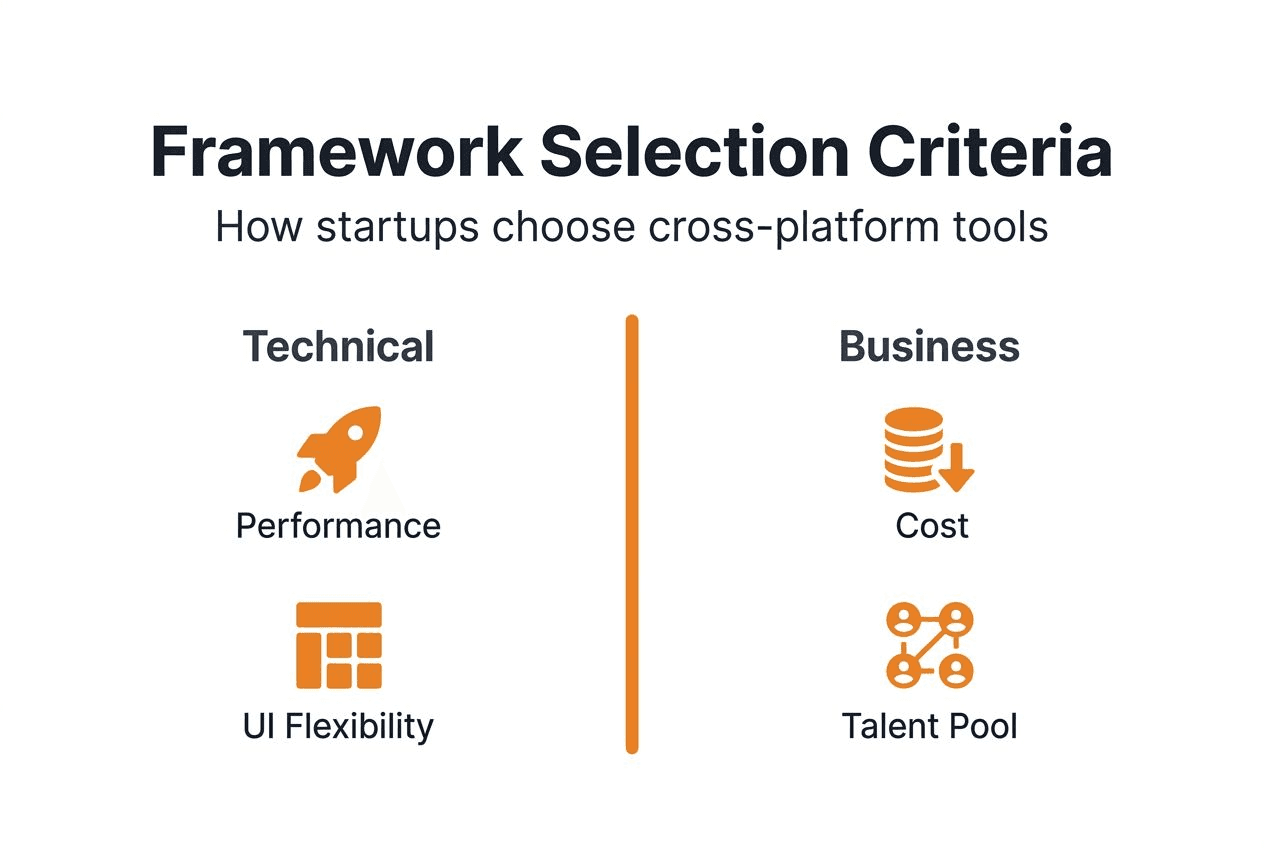
User experience expectations depend on your target audience and competitive landscape. Enterprise users might tolerate functional interfaces while consumer apps face brutal comparisons against polished native competitors. Community support and developer talent availability determine how easily you can hire, onboard, and retain engineering team members.
Key selection criteria include:
Development velocity and time to first release for market validation
Total budget covering initial build plus two years of maintenance and updates
Performance needs for your specific features like real-time updates or complex animations
UX standards expected by your target users compared to native app competitors
Team expertise and learning curve for adopting new languages or frameworks
Long-term maintainability as your codebase grows and requirements evolve
Pro Tip: Prioritize maintainability and local talent availability over cutting-edge features. A framework with abundant California developers prevents costly hiring struggles as you scale your team.
This comparison helps match frameworks to startup priorities:
Criteria | React Native | Flutter | Xamarin |
|---|---|---|---|
Speed to Market | Excellent | Very Good | Good |
Budget Efficiency | Very Good | Very Good | Good |
Performance | Good | Excellent | Good |
Native UX Match | Good | Very Good | Very Good |
Developer Pool | Very Large | Growing | Medium |
Maintenance Ease | Good | Very Good | Fair |
72% of startups prefer React Native for rapid development and community support, making it the safe default choice. However, your specific needs might point toward Flutter's superior rendering or Xamarin's enterprise integration capabilities.
Data-driven comparison beats following trends. Build a scoring matrix weighting criteria by importance to your startup, then evaluate each framework objectively. This systematic approach prevents emotional decisions or choosing based solely on developer preference.
Choosing the right app development framework impacts everything from launch timeline to three-year operational costs. Invest time upfront in this decision rather than rushing into development.
Real-world examples and case studies
A California health startup cut their development timeline by 45 percent using Flutter for a patient engagement app. The framework's hot reload feature let designers and developers iterate rapidly on complex medication tracking interfaces. Custom animations explaining dosage schedules achieved smooth 60fps performance across budget Android devices and premium iPhones alike.
Insurance apps frequently leverage React Native to benefit from JavaScript talent pools and extensive library ecosystems. One Orange County insurtech startup built their claims filing app with React Native, shipping iOS and Android versions simultaneously. They tapped into navigation, payment processing, and document scanning libraries that would have required custom native development otherwise.
A fitness startup chose Xamarin for their enterprise wellness platform serving corporate clients. Their C# backend shared authentication logic and business rules directly with the mobile app, reducing code duplication. Integration with Microsoft Azure services for data storage and analytics happened naturally within the .NET ecosystem.
Lessons from these implementations include:
Scaling requires ongoing investment in performance optimization regardless of framework choice
User engagement metrics show minimal difference between well-built cross-platform and native apps
Maintenance costs rise faster than expected when supporting diverse device portfolios
Choosing frameworks matching your team's existing skills accelerates delivery more than theoretical advantages
Explore how top app developers in California approach framework selection for different industries. Top mobile app development companies often maintain expertise across multiple frameworks to recommend the best fit rather than forcing every project into one technology.
Industry-specific app development demands understanding unique regulatory requirements, user expectations, and integration needs beyond pure technical capabilities.
Conclusion and recommendations for startups
Cross-platform development offers California startups genuine advantages in speed and cost efficiency when implemented thoughtfully. The key lies in matching your framework choice to specific business goals rather than assuming one approach fits all scenarios. Understanding tradeoffs between initial velocity and long-term maintenance prevents budget surprises and technical debt.
Tailored solutions beat one-size-fits-all recommendations every time. Your startup's unique combination of team skills, timeline pressures, budget constraints, and user expectations demands careful framework evaluation. Consider these factors:
Project complexity and performance requirements guiding technical architecture
Available talent pool and learning curve affecting team productivity
Budget for ongoing maintenance beyond initial launch costs
Competitive landscape and UX standards in your market segment
Pro Tip: Budget 15 to 20 percent of development cost annually for maintenance, updates, and UX refinement. Cross-platform apps require continuous attention as platforms evolve and user expectations rise.
Partnering with experienced agencies like TouchZen Media smooths the path from framework selection through production launch. Expert developers identify edge cases early, architect for scalability, and implement platform-specific optimizations that generic cross-platform tutorials miss.
Evaluate your startup needs carefully before committing to any framework. Build prototypes, test with real users, and measure against your success criteria. The right technology choice accelerates your path to product-market fit rather than creating obstacles.
Partner with expert cross-platform app developers
Navigating framework selection and implementation challenges becomes significantly easier with specialized guidance. TouchZen Media delivers tailored app development services that align cross-platform technology choices with your startup's specific goals and constraints.
Our team brings deep expertise across React Native, Flutter, and Xamarin frameworks, recommending the best fit for your project rather than forcing every solution into one technology. We balance speed to market with long-term maintainability, helping you avoid common pitfalls that derail less experienced teams.
Explore our work as a top app developer in California and review portfolios from top mobile app development companies to see cross-platform solutions in action. Contact TouchZen Media for a consultation that turns your app concept into a production-ready solution users love.
Frequently asked questions
What is cross-platform app development?
Cross-platform app development builds applications for multiple operating systems like iOS and Android using a single shared codebase. Instead of writing separate code for each platform, developers use frameworks that compile or interpret the code to run natively on different devices. This approach reduces initial development time and costs compared to building completely separate native apps.
How do I choose the right cross-platform framework for my startup?
Consider your startup's priorities including speed to market, budget constraints, performance requirements, and user experience standards. Evaluate the talent pool and community support for each framework in your local market. Test promising frameworks with small prototypes to reveal integration challenges and performance characteristics before committing to full development. Consult with experienced developers who can provide tailored recommendations based on your specific technical requirements and business goals. Learn more about choosing the right mobile app development framework for your project.
Are cross-platform apps as performant as native apps?
Cross-platform apps can be slightly slower than native apps for computationally intensive tasks due to framework overhead. Frameworks like Flutter offer near-native performance for UI rendering and animations by compiling to native code. Performance depends heavily on optimization efforts, framework choice, and specific project requirements. For most business apps and content-focused applications, cross-platform performance meets user expectations without issues.
What are common challenges when implementing cross-platform apps?
Debugging issues that only appear on specific devices or OS versions increases maintenance complexity significantly. User experience customization requires extra effort to match platform-specific design guidelines and navigation patterns on both iOS and Android. Testing across dozens of device models, screen sizes, and operating system versions becomes critical to catch edge cases before users encounter them. Framework updates occasionally introduce breaking changes requiring code migrations and compatibility fixes.
Does cross-platform development eliminate the need for native code?
Cross-platform frameworks handle most application logic and UI rendering, but edge cases still require platform-specific native code. Accessing cutting-edge platform features immediately upon release often needs native modules until framework support arrives. Complex integrations with device hardware or third-party SDKs sometimes demand native implementations wrapped in cross-platform interfaces. Successful cross-platform projects maintain some native development expertise on the team.
How much can startups save with cross-platform development?
Initial development costs typically run 30 to 40 percent lower than building separate native apps for iOS and Android. However, total cost of ownership over three years includes maintenance, updates, and platform-specific optimizations that reduce the savings gap. Budget for ongoing costs of supporting two platforms, testing across device portfolios, and refining UX to match native standards. Actual savings depend on project complexity, team expertise, and long-term maintenance requirements.