Cyrus Kiani
Founder / CEO



In-House vs Agency Development: How to Choose the Best Solution
Many founders assume building an in-house development team is always the superior choice for creating their mobile or web app. This belief stems from a desire for control and direct oversight. However, the reality is far more nuanced. Choosing between in-house and agency development involves weighing multiple factors including cost structures, speed to market, technical expertise, and long-term strategic goals. This guide breaks down the critical pros and cons of each approach, helping you make an informed decision that aligns with your startup's unique needs and growth trajectory.
Key Takeaways
Point | Details |
|---|---|
In house control tradeoffs | Offers full product control and alignment but requires significant ongoing hiring, salaries, and overhead. |
Agency speed and expertise | Agencies provide specialized skills and faster delivery with less direct day to day control. |
Cost and risk balance | Total ownership cost varies by method and project complexity, so budgeting should reflect fixed and variable expenses. |
Complexity guides option | More complex apps may justify in house teams or specialist agencies depending on needs and timelines. |
Understanding in-house development: benefits and challenges
In-house development means assembling your own team of designers, developers, product managers, and quality assurance specialists who work exclusively on your company's projects. These employees become part of your organizational culture and report directly to your leadership.
The primary advantage is complete control over every aspect of your product development. You set priorities, adjust timelines, and pivot strategies without negotiating with external parties. Your team understands your business intimately and can make decisions aligned with company values. This deep integration often leads to better product-market fit and faster iteration cycles once the team is established.
Culture alignment represents another significant benefit. When developers share your mission and values, they bring passion and commitment that transcends typical employment relationships. This emotional investment can drive innovation and quality improvements that purely transactional relationships rarely achieve.
However, building and maintaining an in-house team requires significant investment in hiring, training, and retention costs. Recruiting skilled developers in competitive markets takes months and demands substantial resources. Salaries, benefits, equipment, office space, and ongoing training create fixed costs that persist regardless of project status.
Key challenges include:
Recruitment difficulty in competitive talent markets with extended hiring timelines
High fixed overhead costs including salaries, benefits, equipment, and workspace
Limited skill diversity compared to specialized agency teams
Retention challenges requiring competitive compensation and career development
Management complexity as team size grows
Pro Tip: Before committing to in-house development, calculate your total cost of ownership including recruitment fees, salaries, benefits, equipment, software licenses, and management overhead. Compare this against agency quotes for a realistic financial picture.
Successful in-house development requires long-term commitment and substantial capital reserves. Startups must maintain payroll during slow periods and invest continuously in skill development as technologies evolve. This model works best when you have predictable, ongoing development needs that justify permanent staff. Understanding the end-to-end app development process helps you assess whether your project scope warrants building an internal team.
Exploring agency development: advantages and considerations
Agency development involves partnering with external firms that specialize in creating mobile and web applications. These companies maintain established teams of designers, developers, project managers, and quality assurance specialists who work on multiple client projects.
The standout advantage is immediate access to specialized expertise across multiple disciplines. Agencies employ professionals who have solved similar problems dozens of times, bringing battle-tested solutions and best practices. This accumulated knowledge accelerates development and helps avoid common pitfalls that inexperienced teams encounter.

Outsourcing app development to agenciescan accelerate time to market and reduce fixed expenses. You skip the lengthy hiring process and start development within weeks rather than months. Agencies also handle administrative burdens like payroll, benefits, and equipment, converting fixed costs into variable project expenses.
Scalability represents another compelling benefit. Agencies can quickly expand or contract team size based on project phases. Need additional developers for a sprint? They can allocate resources immediately. Project winding down? Scale back without layoffs or severance complications.
Key advantages include:
Rapid project initiation with established teams and proven processes
Diverse skill sets spanning design, development, testing, and deployment
Reduced financial risk through project-based pricing models
Access to latest tools, technologies, and industry best practices
Professional project management and quality assurance systems
Pro Tip: When evaluating agencies, request case studies from similar industries and ask about their team structure. Understanding who will actually work on your project prevents surprises and ensures you get the expertise you need.
Potential drawbacks require careful consideration. You have less direct control over daily operations and must communicate through established channels rather than walking over to a developer's desk. Dependence on external timelines means your priorities compete with other client projects. Some agencies struggle with truly understanding your business context, potentially leading to solutions that work technically but miss strategic nuances.
Communication management becomes critical for agency success. Establishing clear expectations, regular check-ins, and detailed documentation prevents misunderstandings and keeps projects on track. Researching top IT consultants helps identify partners with strong communication practices and proven track records.
Financial and strategic comparison: cost, speed, and quality
Understanding the financial implications of each development model requires looking beyond simple hourly rates to total cost of ownership and strategic value delivery.
Cost structures differ fundamentally between approaches. In-house development involves high upfront investment in recruitment, onboarding, and infrastructure, followed by fixed monthly costs regardless of productivity. A small team of three developers with supporting roles easily costs $500,000 annually when including salaries, benefits, equipment, software licenses, and management overhead. These costs continue during planning phases, slow periods, and between projects.
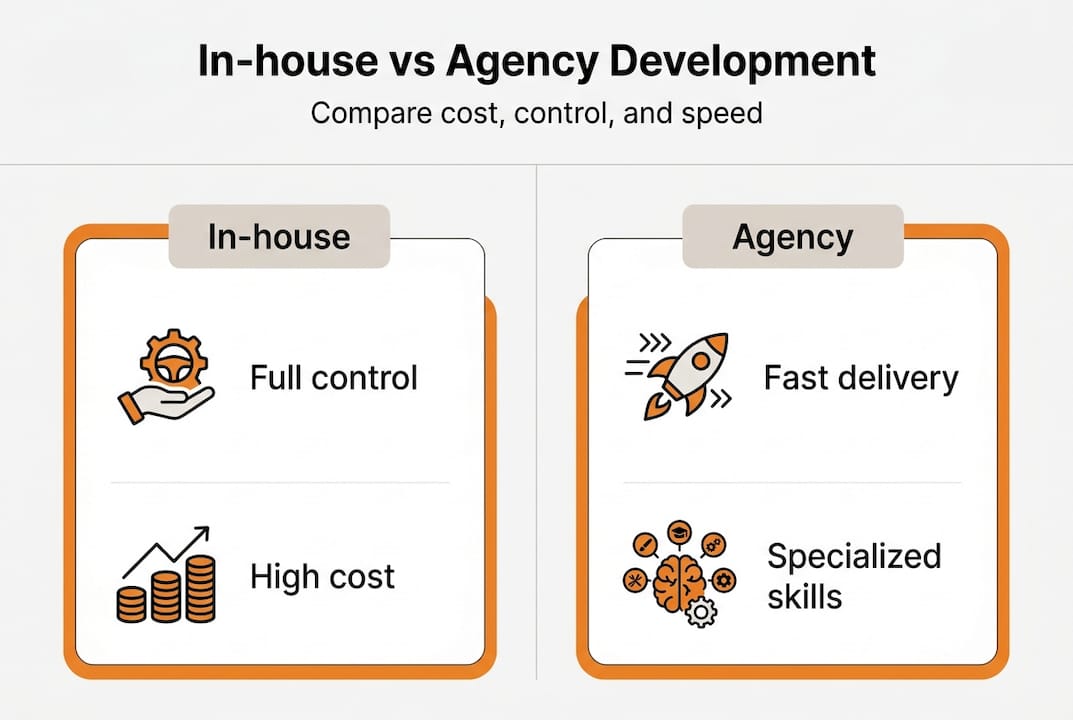
Agency development typically operates on project-based pricing with clear deliverables and timelines. Startups should consider both direct and hidden costs when choosing between in-house and agency development. While hourly rates may appear higher, you pay only for active development without carrying fixed overhead. A $150,000 agency project might deliver the same outcome as six months of in-house work costing $250,000 when accounting for full team expenses.
Speed to market varies significantly based on project complexity and team readiness. In-house teams require two to four months for recruitment and onboarding before productive development begins. Agencies start within weeks, leveraging existing teams and established workflows. For time-sensitive launches or competitive markets, this speed advantage can determine success or failure.
Key financial and strategic factors:
In-house fixed costs remain constant regardless of project activity or productivity
Agency variable costs align directly with development phases and deliverables
Speed advantages favor agencies for initial launches and in-house for ongoing iterations
Quality depends more on team capability than employment model
Project complexity influences which model delivers better value
Quality outcomes depend primarily on team expertise rather than employment structure. Excellent in-house teams produce outstanding products, as do top-tier agencies. The key is matching team capability to project requirements. Simple applications may not justify elite talent, while complex enterprise solutions demand deep expertise regardless of source.
Maintenance and evolution present different challenges. In-house teams provide continuity and institutional knowledge but require ongoing investment during maintenance phases when development slows. Agencies offer flexible engagement models, scaling support up or down as needed, but may lack the deep product understanding that comes from daily immersion.
Exploring top mobile app development services reveals the range of agency capabilities and pricing models available to startups evaluating their options.
Making the choice: when to build in-house vs hire an agency
Selecting the right development approach requires honest assessment of your startup's current situation, resources, and long-term vision. Ask yourself these critical questions before committing to either path.
What is your timeline for launch? If you need to reach market within three to six months, agencies provide the fastest path. Building an in-house team requires patience and tolerance for extended timelines.
Do you have sufficient capital reserves? In-house development demands substantial upfront investment and ongoing fixed costs. Ensure you can sustain team expenses for at least 18 months regardless of revenue or funding fluctuations.
How complex and specialized is your product? Highly technical applications requiring niche expertise often benefit from agency access to specialists. Simpler products with standard features may justify in-house generalists.
What are your long-term product plans? If you envision continuous development and frequent iterations over years, in-house teams provide better long-term value. Single projects or periodic updates favor agency partnerships.
How important is intellectual property control? Some startups require absolute confidentiality and IP ownership, making in-house development preferable despite higher costs.
In-house development excels when you need complete control over product direction, have ongoing development needs justifying permanent staff, prioritize deep cultural alignment, possess capital for sustained investment, and require absolute intellectual property security. Choosing the right development model depends on your startup's growth stage, technical needs, and internal capabilities.
Agency development shines when you need rapid market entry, lack capital for permanent teams, require specialized expertise unavailable locally, have defined project scope with clear endpoints, or want to validate concepts before major investments. Understanding the complete app development process helps you communicate effectively with agency partners and set realistic expectations.
Hybrid approaches offer compelling middle ground for many startups. Maintain a small core in-house team handling strategy, product management, and critical features while partnering with agencies for specialized components, capacity expansion, or specific technical challenges. This model provides control over core competencies while accessing external expertise as needed.
Pro Tip: Start with an agency for your initial product launch, then evaluate building in-house capabilities once you have validated product-market fit and secured stable funding. This approach minimizes risk while preserving future optionality.
Successful execution requires strong management regardless of model chosen. For in-house teams, invest in experienced technical leadership who can recruit effectively, establish engineering culture, and maintain productivity. For agency partnerships, assign dedicated internal stakeholders who can communicate requirements clearly, provide timely feedback, and make decisions quickly. Learn from business development terminology to communicate effectively with technical teams and partners.
How TouchZen Media supports your app development journey
Navigating the complexities of app development requires a partner who understands both the technical challenges and strategic considerations facing startups and growing companies. TouchZen Media specializes in creating high-quality mobile and web applications for founders who need expert execution without the overhead of building internal teams.
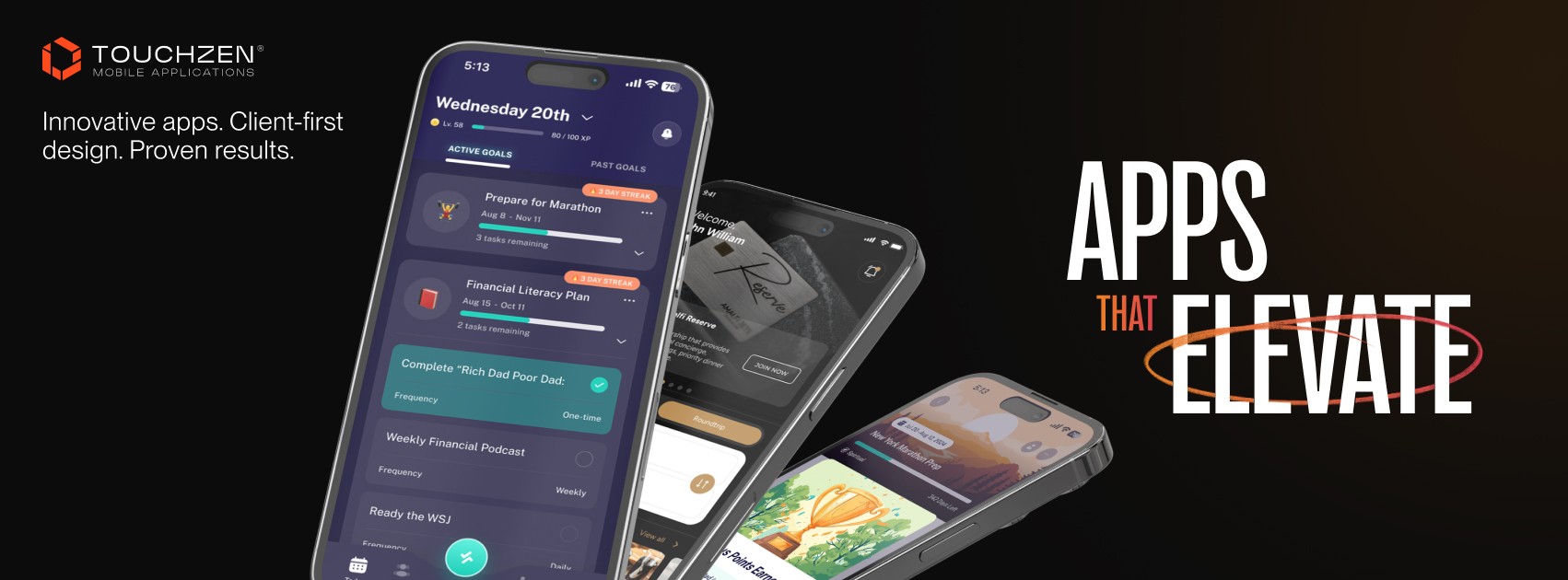
Our Orange County based agency brings together experienced designers, developers, and strategists who have launched successful apps across insurance, health, travel, fitness, and numerous other industries. We provide the specialized expertise and proven processes that accelerate time to market while maintaining the quality and attention to detail your product deserves. Whether you need native iOS and Android development, responsive web applications, or comprehensive digital solutions, our team collaborates closely with you to bring your vision to life. Explore our credentials as top app developers and discover why startups trust us as one of the top mobile app development companies. Connect with our app experts to discuss your project and learn how we can help you achieve your digital goals.
FAQ
What are the main cost differences between in-house and agency development?
In-house development involves fixed costs including salaries, benefits, equipment, office space, and ongoing training that persist regardless of project activity. Agencies typically charge project-based fees or hourly rates without requiring long-term financial commitments. While agency hourly rates may appear higher, total cost often favors agencies when accounting for recruitment, overhead, and periods between projects. The best choice depends on your project duration and ongoing development needs.
How do communication and control differ between in-house and agency teams?
In-house teams offer direct daily oversight with immediate access to developers and designers, enabling quick decisions and course corrections. Agency relationships require structured communication through scheduled meetings, project management tools, and designated points of contact. However, professional agencies bring experienced project managers who facilitate clear communication and keep projects on track. Success with either model depends on establishing clear expectations and maintaining consistent dialogue.
Can startups effectively combine in-house and agency development?
Hybrid models allow startups to maintain strategic control through small internal teams while leveraging agency expertise for specialized components or capacity expansion. This approach optimizes resource allocation by keeping critical functions in-house while outsourcing areas requiring niche skills or temporary scale. Proper coordination through clear role definitions, shared project management systems, and regular alignment meetings ensures seamless collaboration. Many successful startups use this model to balance control with access to broader expertise, as detailed in our end-to-end app development guide.
How long does it take to see results with each development approach?
Agencies typically begin productive development within two to four weeks after project kickoff, leveraging existing teams and established processes. In-house teams require two to four months for recruitment, onboarding, and team formation before reaching full productivity. Initial results appear faster with agencies, though mature in-house teams may iterate more quickly on subsequent features due to accumulated product knowledge. Your timeline requirements should heavily influence your choice between these approaches.
What happens if my chosen development approach is not working?
Switching from in-house to agency development involves transitioning knowledge, code repositories, and product documentation to external partners, which typically takes two to four weeks. Moving from agency to in-house requires recruiting team members and knowledge transfer from the agency, often spanning three to six months. Both transitions carry costs and risks, making the initial choice critical. Start with thorough evaluation and clear success metrics to minimize the need for mid-project changes.